Solute
Definition and meaning of Solute in chemistry.
A solute is the substance that dissolves in a solvent to form a solution, and it is usually the component present in the smaller amount. Solutes can be solids, liquids, or gases, such as table salt, ethanol, or the carbon dioxide in soda. Once dissolved, solute particles spread evenly and do not settle out.
In more detail
Three words describe every solution, and they are easy to keep straight. The solute is whatever gets dissolved. The solvent is whatever does the dissolving.
The solution is the uniform mixture that results. Stir a spoonful of table salt into a glass of water and the salt is the solute, the water is the solvent, and the clear salty liquid is the solution. Nothing about that salt disappeared.
The mass of the solution equals the mass of the salt plus the mass of the water, and boiling the water away leaves the salt behind. Dissolved solute particles are far too small to see or to filter out, and they never settle to the bottom. That last point is what separates a true solution from a suspension like muddy water.
How do you tell which substance is the solute?
Two rules cover almost every case. First, if one substance changes state during mixing, that one is the solute, so solid salt entering liquid water is the solute. Second, when both components start in the same state, the one present in the smaller amount is the solute.
In rubbing alcohol that is 70 percent isopropanol and 30 percent water, the water is the solute. One convention overrides that rule: chemists call water the solvent in any water-based solution, even concentrated sulfuric acid, where the acid is the larger share. Solutes are not always solid.
Sugar is a solid solute, the ethanol in a tincture is a liquid solute, and the carbon dioxide that fizzes out of soda is a gaseous solute. Solutions do not have to be liquid either. Brass is a solid solution of zinc solute in copper solvent, and air is a gaseous solution in which oxygen and argon are solutes in nitrogen.
What actually happens when a solute dissolves?
Dissolving is a tug of war between forces. Solvent particles crowd the surface of the solute and pull individual particles away from the bulk. Each freed particle then ends up surrounded by a shell of solvent, a process called solvation, or hydration when the solvent is water.
Dissolving only proceeds when the solute-solvent attractions are strong enough to repay the energy spent pulling the solute apart, which is why oil will not dissolve in water. This is also why dissolving is not melting. Melting takes one pure substance and adds heat until the solid turns liquid.
Dissolving needs a second substance to do the work, and it happens far below the solute's melting point. Table salt melts at 801 degrees Celsius, yet it dissolves readily in room-temperature water.
Electrolyte and nonelectrolyte solutes
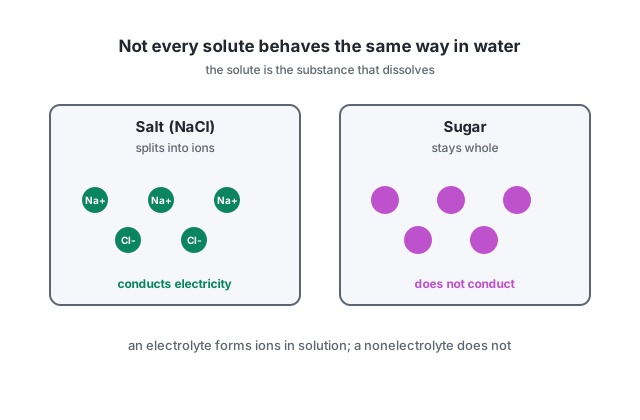
Not every solute breaks apart the same way, and the difference matters. Ionic solutes such as sodium chloride dissociate: NaCl separates into Na+ and Cl- ions, so one formula unit yields two dissolved particles. The solution conducts electricity, and the solute is called an electrolyte.
Molecular solutes such as sucrose dissolve as whole, intact molecules. One sucrose molecule gives one dissolved particle, the solution does not conduct, and the solute is a nonelectrolyte. Strong acids and bases are electrolytes too, while weak acids like acetic acid only partly ionize.
How is solute concentration measured?
Molarity is the workhorse: M equals moles of solute divided by liters of solution. Read that wording carefully, because it is a classic exam trap. The denominator is the final volume of the whole solution, not the volume of solvent you started with.
Mass percent is the mass of solute divided by the mass of solution, times 100. Parts per million is that same ratio times one million, used for very dilute solutions like fluoride in drinking water. Worked example: dissolve 29.2 g of sodium chloride in enough water to reach a total volume of 500.0 mL.
The molar mass of NaCl is 58.44 g/mol, so moles = 29.2 g / 58.44 g/mol = 0.500 mol. Convert the volume, since 500.0 mL = 0.5000 L. Then M = 0.500 mol / 0.5000 L = 1.00 M.
Solubility and saturation
A solvent can only hold so much solute. About 36 grams of sodium chloride dissolve in 100 grams of water at room temperature, and anything beyond that sits on the bottom. A solution holding the maximum is saturated, one holding less is unsaturated, and one coaxed into holding more is supersaturated and unstable.
Heating usually raises the solubility of solid solutes but lowers it for gases, which is why warm soda goes flat fast.
Why does salt melt ice on roads?
Adding any solute lowers a solvent's freezing point and raises its boiling point. These are colligative properties, meaning they depend on how many dissolved particles are present, not on what those particles are. For water, each mole of dissolved particles per kilogram of solvent lowers the freezing point by 1.86 degrees Celsius and raises the boiling point by 0.512 degrees Celsius.
Because sodium chloride splits into two ions, a 1-molal salt solution drops the freezing point by roughly 2 x 1.86 = 3.72 degrees Celsius, about twice the effect of 1-molal sugar. That is why road crews spread salt, not sugar, though it stops working well below about -9 degrees Celsius.
Key facts
| Field | General Chemistry |
|---|---|
| Role | The substance being dissolved |
| Identifying rule | Usually the component present in the smaller amount |
| Possible states | Solid, liquid, or gas |
| Main concentration unit | Molarity (M) = moles of solute / liters of solution |
| Electrolyte solute | Dissociates into ions and conducts electricity, such as NaCl |
| Nonelectrolyte solute | Dissolves as whole molecules and does not conduct, such as sucrose |
| Solubility limit | A saturated solution holds the maximum solute at that temperature |
| Colligative effect | Lowers the solvent's freezing point and raises its boiling point |
Open a can of soda and you can watch a solute leave a solution. Carbon dioxide was forced into the liquid under pressure, making it a gaseous solute in a water solvent. Releasing the tab drops the pressure, the gas becomes less soluble, and it escapes as bubbles. The sugar dissolved in the same can is a solid solute, and it stays put because solid solubility does not depend on pressure.
Frequently asked questions
What is the difference between a solute and a solvent?
The solute is the substance that dissolves, and the solvent is the substance that does the dissolving. The solvent is normally present in the larger amount and keeps its own physical state in the final mixture. In salt water, salt is the solute and water is the solvent, and together they make the solution.
How do you identify the solute when both substances are liquids?
Compare the amounts and call the smaller one the solute. In a mixture that is 70 percent isopropanol and 30 percent water, the water is the solute. There is one common exception: if water is present at all in a laboratory solution, chemists usually name water as the solvent by convention, even when the other component is more abundant.
Is dissolving the same as melting?
No. Melting involves a single pure substance and requires enough heat to reach its melting point. Dissolving requires a second substance, the solvent, whose particles pull the solute apart. Sodium chloride melts at 801 degrees Celsius but dissolves easily in water at room temperature, which shows the two processes are unrelated.
Why does salt water conduct electricity but sugar water does not?
Sodium chloride is an electrolyte, so it dissociates in water into Na ions and Cl ions that are free to move and carry charge. Sucrose is a nonelectrolyte, so it dissolves as whole neutral molecules with no free charges. Conduction needs mobile charged particles, and sugar water simply does not have any.
Does molarity use the volume of the solvent or the whole solution?
The whole solution. Molarity is moles of solute divided by liters of final solution, so you add solvent until the total volume hits the mark rather than measuring the solvent first. Dissolving a solute can slightly change the total volume, which is why the definition specifies solution volume.
Can a gas be a solute?
Yes. Carbon dioxide dissolved in soda and oxygen dissolved in lake water are both gaseous solutes. Gas solubility behaves differently from solid solubility, since it increases with pressure and decreases as temperature rises. That is why a sealed soda holds its fizz and a warm open one goes flat.
What does it mean for a solution to be saturated?
A saturated solution holds the maximum amount of solute that will dissolve at a given temperature, so any extra solute stays undissolved at the bottom. Below that limit the solution is unsaturated. A supersaturated solution temporarily holds more than the limit, usually after careful cooling, and it crystallizes suddenly when disturbed.
Why does adding a solute lower the freezing point of water?
Solute particles get in the way of water molecules trying to lock into an ice lattice, so the mixture has to be cooled further before it freezes. The size of the drop depends on the number of dissolved particles, not their identity. Sodium chloride releases two ions per formula unit, which makes it roughly twice as effective per mole as sugar.