Precipitate
Definition and meaning of Precipitate in chemistry.
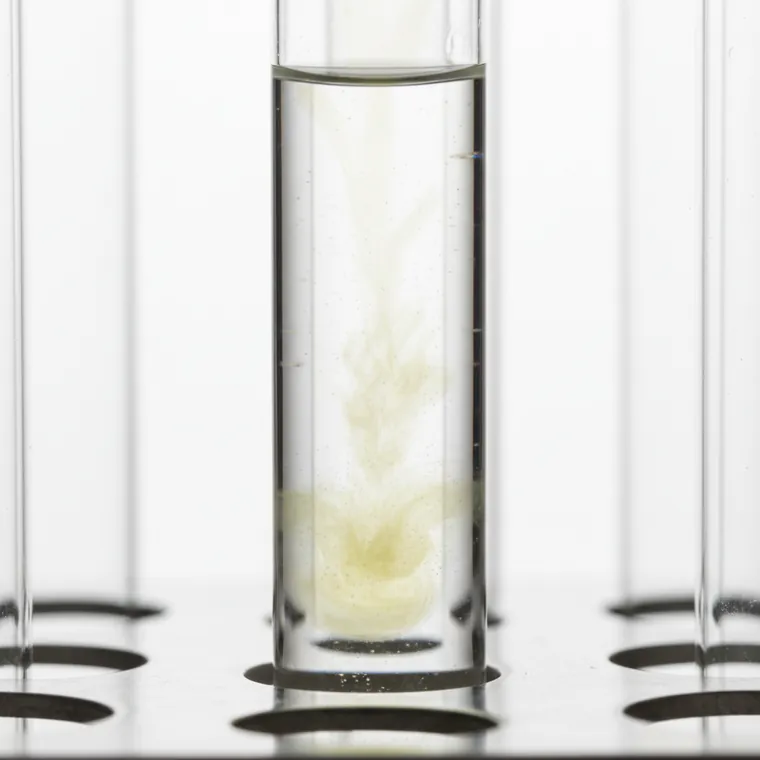
A precipitate is a solid that forms and separates out of a solution when dissolved ions combine into an insoluble compound. This happens when the ion concentrations in solution exceed a limit called the solubility product constant, or Ksp. The result is a visible solid suspended in or settling out of the liquid.
In more detail
Precipitation reactions usually happen when two solutions containing different dissolved ions are mixed together. If the combined ions form a compound that cannot stay dissolved at that concentration, the compound separates as a solid. Chemists compare the reaction quotient, Q, calculated from the current ion concentrations, to the solubility product constant, Ksp, for that compound.
When Q exceeds Ksp, the solution is supersaturated and a precipitate forms until equilibrium is restored. Precipitates play a major role in qualitative analysis, a method chemists use to identify unknown ions in a sample. By adding specific reagents and watching which precipitates form, along with their color and texture, chemists can determine which ions were originally present.
Precipitation is also used in gravimetric analysis. In this method, a precipitate is filtered, dried, and weighed to calculate the exact amount of a substance in the original sample. Precipitation reactions are also classified as a type of double displacement reaction.
The cations and anions of the two reactants swap partners to form new compounds. Solubility rules, which summarize which combinations of ions typically dissolve in water, help chemists predict whether a precipitate will form before running the reaction.
Key facts
| Field | Inorganic Chemistry |
|---|---|
| Common example | AgCl (silver chloride, white solid) |
| Formation condition | Ion product (Q) exceeds Ksp |
| Primary application | Qualitative and gravimetric analysis |
| Appearance | Solid particles suspended in or settled out of a solution |
Mixing a solution of silver nitrate (AgNO3) with a solution of sodium chloride (NaCl) instantly produces a white precipitate of silver chloride (AgCl). The sodium and nitrate ions remain dissolved in solution, since sodium nitrate is soluble in water.
Frequently asked questions
What causes a precipitate to form?
A precipitate forms when the ionic product (Q) of dissolved ions exceeds the solubility product constant (Ksp) for that compound, causing it to become insoluble and separate as a solid.
How is precipitate used in chemistry?
Precipitates are used in qualitative analysis to identify specific ions, in gravimetric analysis to measure ion concentrations, and in laboratory synthesis to isolate compounds.
How can you separate a precipitate from a solution?
Filtration is the most common method. The mixture is poured through filter paper, which traps the solid precipitate while the liquid, called the filtrate, passes through.