Fat
Definition and meaning of Fat in chemistry.
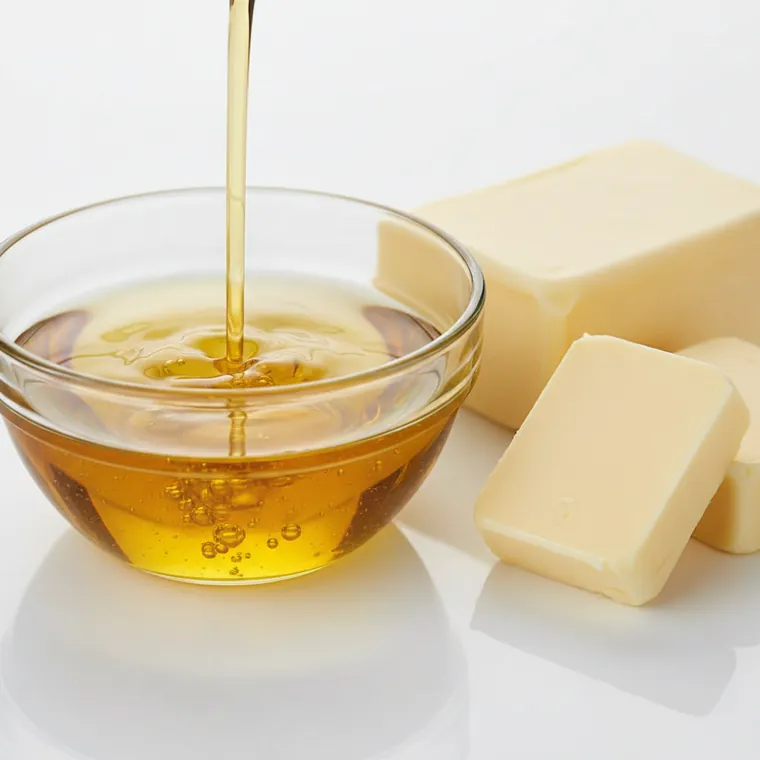
A fat is a large lipid molecule used for concentrated long-term energy storage in living organisms. Chemically, it is a triglyceride formed by joining one glycerol molecule to three fatty acid chains. Fats are typically solid at room temperature, which distinguishes them from liquid oils.
In more detail
Fats belong to a broader class of biological molecules called lipids, which do not dissolve in water. Each fatty acid attaches to the glycerol backbone through a chemical connection called an ester bond. Forming these three ester bonds releases three water molecules in a process called condensation synthesis.
Breaking these bonds apart with a strong base produces glycerol and fatty acid salts called soap. Fats contain mostly saturated fatty acids, meaning their carbon chains hold the maximum possible hydrogen atoms. These saturated carbon chains are perfectly straight, allowing the molecules to pack tightly together into solids.
Oils contain unsaturated fatty acids with double bonds that create stiff bends in the carbon chain. These bent chains cannot pack tightly together, which keeps oils in a liquid state at room temperature. The long hydrocarbon chains in fats contain many carbon-hydrogen bonds packed with potential chemical energy. Oxidizing fat yields roughly nine kilocalories per gram, providing more than double the energy of carbohydrates.
Key facts
| Field | Biochemistry |
|---|---|
| Chemical Class | Triglyceride, which is a triester of glycerol and three fatty acids. |
| Energy Density | Provides roughly 9 kilocalories per gram when fully oxidized. |
| Physical State | Solid at room temperature due to tightly packed saturated fatty acid chains. |
| Solubility | Highly nonpolar and completely insoluble in liquid water. |
| Industrial Use | Converted into traditional soap and glycerol through a chemical process called saponification. |
Tristearin is a common solid fat found abundantly in beef fat and other animal tissues. It forms when one glycerol molecule bonds with three molecules of a saturated fatty acid called stearic acid. The straight 18-carbon chains of stearic acid pack densely, giving tristearin a high melting point. This tight molecular packing makes tristearin an excellent solid energy reserve for animals during winter. Industrially, manufacturers boil tristearin with sodium hydroxide lye to produce hard bar soaps and candles.
Frequently asked questions
What is the chemical difference between a fat and an oil?
Both are triglycerides, but fats contain mostly straight saturated fatty acids that pack into solids. Oils contain bent unsaturated fatty acids that remain loosely packed liquids.
Why does digesting fat release more energy than digesting sugar?
The hydrocarbon chains in fats have many more high-energy carbon-hydrogen bonds than sugars do. This chemical structure releases roughly twice as much energy per gram during oxidation.
Are all dietary fats bad for human health?
No, dietary fats are essential for survival. They help the body absorb vital vitamins, build healthy cell membranes, and protect internal organs from physical shock.