Distillation
Definition and meaning of Distillation in chemistry.
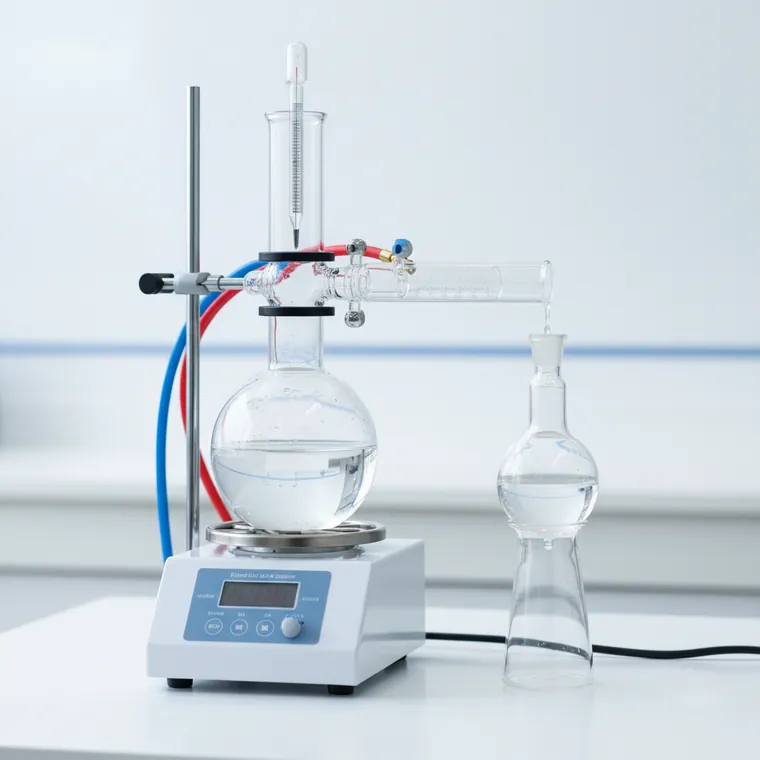
Distillation is a method that separates liquids based on their boiling points. A mixture is heated until the liquid with the lower boiling point turns into vapor. That vapor is then cooled back into a liquid in a separate container, leaving the rest behind.
In more detail
Vapor rising off a heated mixture holds more of whichever liquid boils at a lower temperature. Collecting and cooling that vapor gives a new liquid richer in that lighter component. Simple distillation uses only one heating and cooling step.
It works well when two boiling points differ by more than about 25 degrees Celsius. Fractional distillation adds a tall column packed inside with material. Vapor rises through the column and condenses again and again as it climbs.
Each cycle makes the vapor a bit purer than the last. This lets chemists separate liquids whose boiling points sit close together. Some liquid pairs form an azeotrope.
This is a blend that boils at one fixed temperature, and it never gets purer through ordinary distillation. Vacuum distillation lowers the pressure inside the setup. Liquids then boil at lower temperatures, which protects heat sensitive compounds from breaking down.
Oil refineries rely on distillation to split crude oil into gasoline, diesel, and other fuels. Chemistry labs use it every day to purify solvents. Steam distillation injects steam into a mixture to carry out volatile compounds without heating them too much. This gentler method works well for extracting fragrant oils from plants.
Key facts
| Field | General Chemistry |
|---|---|
| Physical basis | Differences in boiling point and vapor pressure |
| Common types | Simple, fractional, vacuum, and steam distillation |
| Key equipment | Flask, fractionating column, condenser, receiving flask |
| Used in | Oil refining, alcohol production, solvent purification |
A whiskey distillery heats a fermented mash of water and ethanol. Ethanol boils at 78.4 degrees Celsius, far below water's 100 degrees Celsius. The rising vapor carries more ethanol than the liquid left behind. Cooling that vapor produces a spirit with a much higher alcohol content than the starting mash.
Frequently asked questions
What is the difference between simple and fractional distillation?
Simple distillation uses one heating and cooling step. It works best when boiling points differ by a lot. Fractional distillation uses a packed column to repeat that step many times. This separates liquids with boiling points that are close together.
Can distillation fully separate an azeotrope?
Not with ordinary distillation. An azeotrope boils at one fixed composition, so its vapor matches the liquid below it. Special methods, like changing the pressure or adding another chemical, are needed to break it apart.
Why does vacuum distillation use lower pressure?
Lowering the pressure makes liquids boil at lower temperatures. This helps purify compounds that would break down or react if heated to their normal boiling point.