Helium
Definition and meaning of Helium in chemistry.
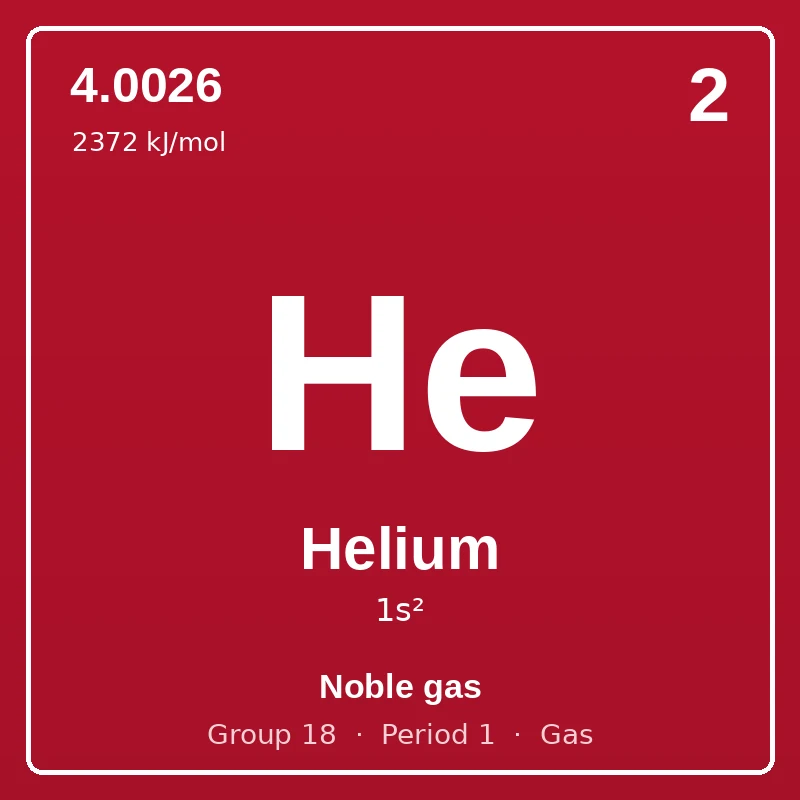
Helium is the second-lightest chemical element found in the known universe. It is a colorless, odorless, and chemically inert noble gas. It sits at the top right of the periodic table with the chemical symbol He.
In more detail
Helium belongs to the highly unreactive noble gas group on the periodic table. Every neutral helium atom has exactly two electrons orbiting its central nucleus. These two negatively charged electrons completely fill its innermost 1s electron shell.
This completely full outer shell gives helium an extremely stable atomic configuration. Because of this stability, helium has the highest first ionization energy of any element. It takes massive amounts of applied energy to remove an electron from a helium atom.
Therefore, helium forms essentially no stable chemical compounds under ordinary laboratory conditions. It will not burn, explode, or react chemically with other known elements. Helium also exhibits some truly fascinating physical properties at extremely low temperatures.
It possesses the absolute lowest boiling point of any known chemical substance. You cannot freeze helium into a solid by simply cooling it at normal atmospheric pressure. It requires extreme mechanical compression combined with cold temperatures to become solid.
A common student misconception is that commercial helium is simply extracted from the air. Actually, most terrestrial helium originates deep underground from natural radioactive decay processes. Heavy radioactive elements like uranium and thorium undergo slow alpha decay in Earth's crust.
This slow radioactive decay releases energetic alpha particles, which are bare helium nuclei. These positively charged nuclei quickly capture stray electrons to become neutral helium gas. This trapped gas accumulates over millions of years within subterranean rock formations. Energy companies then extract it alongside certain deep underground natural gas deposits.
Key facts
| Field | General Chemistry |
|---|---|
| Symbol | He |
| Atomic number | 2 |
| Atomic mass | 4.0026 u |
| Category | Noble-Gas |
| Boiling point | 4.22 K (-268.93°C) |
| Electron configuration | 1s² (a completely filled valence shell) |
Liquid helium is incredibly cold and possesses some entirely unique physical properties. It boils at precisely 4.22 K, which is roughly -269 degrees Celsius. This extreme cold is essential for cooling the powerful superconducting magnets inside MRI scanners. These medical magnets must reach temperatures near absolute zero to operate correctly. Liquid helium provides the only practical way to achieve these extreme cryogenic temperatures.
Frequently asked questions
Why doesn't helium form chemical compounds?
Its 1s² electron configuration is a complete and stable shell. It has no room for extra bonding electrons. Its very high ionization energy also makes it extremely resistant to losing or sharing electrons.
Where does the helium used commercially come from?
It comes almost entirely from the natural alpha decay of uranium and thorium in Earth's crust. This gas slowly accumulates underground and is extracted alongside natural gas.
Why does inhaling helium change the sound of your voice?
Sound travels much faster through light helium gas than through normal air. This faster speed changes the resonant frequencies of your vocal tract and creates a higher pitch.
Related terms
Sources & references
See our sources and editorial standards.