Metal
Definition and meaning of Metal in chemistry.
A metal is a chemical element whose atoms lose their outer electrons easily and form positive ions. Metals occupy the left side and center of the periodic table, where they make up the large majority of elements. Their shared pool of loose electrons explains why they conduct electricity and heat, shine, and bend without breaking.
In more detail
The chemical test for a metal has nothing to do with shine. A metal is an element whose atoms give up their outer electrons easily, leaving a positive ion called a cation. Sodium loses one electron to become Na+, magnesium loses two to become Mg2+, and aluminum loses three to become Al3+.
Chemists measure that willingness as ionization energy, the energy needed to strip an electron from an atom, and metals have low values. Nonmetals hold their electrons tightly instead.
Where do metals sit on the periodic table?
Metals fill the left side and the whole center of the table, and they are the large majority of the elements, roughly four out of every five. A zigzag staircase line runs down the right-hand side, starting between boron and aluminum and stepping down until it passes astatine.
Metals lie to its left and nonmetals to its right. The elements along the line are the metalloids: boron, silicon, germanium, arsenic, antimony, and tellurium. Polonium and astatine are awkward, and tables disagree on whether to call them metalloids, metals, or nonmetals. Aluminum touches the staircase too, but it is a metal by every practical test.
Why does one idea explain almost every metal property?
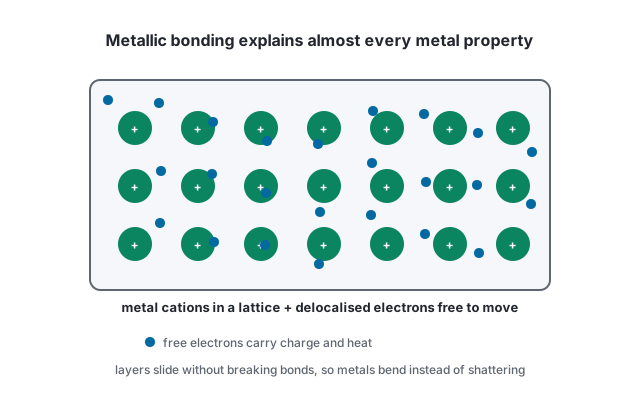
That idea is metallic bonding. In a solid metal the atoms release their outer electrons into a shared pool, so the structure is a lattice of cations sitting in a sea of delocalized electrons, meaning electrons owned by the whole crystal instead of one atom.
Those loose electrons drift when a voltage is applied, so metals conduct electricity, and they ferry heat through the solid the same way. Metallic bonds point in no particular direction, so a layer of cations can slide to a new position while the electron sea flows with it.
That is why metals are malleable, hammered into sheets, and ductile, drawn into wire, while an ionic crystal shatters under the same blow. Free electrons at the surface absorb and re-emit light, which is the shine.
Which metals break the rules?
Property lists call metals hard, dense solids with high melting points, and plenty of metals ignore that. Mercury is liquid at room temperature, melting near negative 39 degrees Celsius, and gallium melts at about 30 degrees Celsius, warm enough to melt in a closed hand. The alkali metals are soft enough to cut with a knife, and lithium, sodium, and potassium float on water while reacting with it because they are less dense. So treat the property list as typical behavior rather than a definition.
What are the main families of metals?
Group 1, the alkali metals, have one valence electron, form +1 ions, and are the most reactive metals, so they are stored under oil. Group 2, the alkaline earth metals, have two valence electrons, form +2 ions, and are harder and less reactive. Transition metals in groups 3 to 12 fill d orbitals, which gives them several oxidation states, colored compounds, and useful catalytic behavior; iron, copper, and nickel sit here.
Post-transition metals such as aluminum, tin, and lead lie just left of the staircase and are softer. The lanthanides and actinides are the two rows printed below the table: lanthanides are the rare earth metals, and every actinide is radioactive.
How do chemists rank metal reactivity?
Reactivity climbs going down a group, because the outer electron sits farther from the nucleus with more shells shielding it, so it comes away more easily. Potassium therefore reacts with water far more violently than sodium. The reactivity series lists metals in that order: potassium, sodium, calcium, magnesium, aluminum, zinc, iron, lead, then hydrogen, then copper, silver, and gold.
A metal higher in the series pushes a lower one out of its compound in solution, as in Zn + CuSO4 -> ZnSO4 + Cu. Take 6.54 g of zinc. Zinc's molar mass is 65.4 g/mol, so 6.54 / 65.4 = 0.100 mol.
The ratio is one to one, so 0.100 mol of copper forms, and at 63.5 g/mol that comes to 0.100 x 63.5 = 6.35 g.
Why are metal oxides basic?
Oxidize a metal and you get a metal oxide, and metal oxides are basic. The soluble ones dissolve to give hydroxide solutions: Na2O + H2O -> 2NaOH, and CaO + H2O -> Ca(OH)2. Insoluble ones still neutralize acids, as in MgO + 2HCl -> MgCl2 + H2O.
Nonmetal oxides do the opposite and form acids. Amphoteric oxides such as aluminum oxide and zinc oxide react with both.
What is an alloy?
An alloy is a solid solution: a metal melted together with other elements and then frozen in place. Steel is iron with a small amount of carbon, usually under 2 percent by mass, and stainless steel adds chromium. Brass is copper and zinc; bronze is copper and tin.
Alloys are harder than the pure metal because the added atoms are a different size, so they disturb the neat layers of cations and stop them sliding.
Why do metals corrode?
Corrosion is a metal losing electrons to its surroundings and turning back into a compound. Rusting is corrosion of iron, and it needs oxygen and water together, so iron in dry air does not rust. Hydrated iron(III) oxide flakes off and exposes fresh metal, so the damage keeps spreading.
Aluminum corrodes too, but its oxide layer is thin, tough, and firmly attached, so it seals the surface instead.
Key facts
| Field | Inorganic Chemistry |
|---|---|
| Defining behavior | Loses valence electrons easily to form cations |
| Bonding | Metallic bonding: a lattice of cations in a sea of delocalized electrons |
| Periodic table location | Left side and center, roughly four of every five known elements |
| Boundary with nonmetals | The staircase line from boron down past astatine, with metalloids along it |
| Typical properties | Lustrous, malleable, ductile, and conductive of heat and electricity |
| Honest exceptions | Mercury is liquid at room temperature; alkali metals cut with a knife |
| Oxides | Metal oxides are basic; Al2O3 and ZnO are amphoteric |
| Common alloys | Steel (iron and carbon), brass (copper and zinc), bronze (copper and tin) |
Strip the plastic from a household copper wire and every metal property shows up at once. The fresh surface is bright because free electrons at the surface bounce light back. The wire carries current because those same electrons drift along it. Bend it and it does not snap, since layers of copper ions slide past each other while the electron sea flows along. Leave it out and it slowly dulls as copper oxide forms.
Frequently asked questions
What makes an element a metal?
A metal is an element whose atoms lose their outer electrons easily, forming positive ions called cations. That happens because metals have low ionization energy, the energy needed to remove an electron. The familiar physical traits, shine, bending, and conductivity, all follow from that same electron behavior rather than defining it.
Where is the dividing line between metals and nonmetals?
A zigzag staircase line on the right side of the periodic table separates them, running from boron down and across until it passes astatine. Metals sit to the left, nonmetals to the right, and metalloids sit along the line itself. Polonium and astatine are borderline, so different tables classify them differently.
Why do metals conduct electricity so well?
In a metal the outer electrons are delocalized, meaning they are not tied to any single atom and can move through the whole crystal. Apply a voltage and that sea of electrons drifts, which is an electric current. The same mobile electrons also carry heat, which is why metals feel cold to the touch.
Are all metals solid at room temperature?
Almost all of them are, but mercury is a liquid, melting near negative 39 degrees Celsius. Gallium melts at about 30 degrees Celsius, so it turns liquid in a warm hand. Hardness varies just as widely, since the alkali metals are soft enough to slice with a knife.
What is the difference between a metal, a nonmetal, and a metalloid?
Metals lose electrons and form cations, while nonmetals gain or share electrons and form anions. Metalloids such as silicon and germanium sit on the staircase line and show a mix of both behaviors, which is why they work as semiconductors. Metal oxides are basic while nonmetal oxides are acidic.
Why is an alloy usually stronger than a pure metal?
A pure metal deforms because its identical cations are stacked in neat layers that slide over one another. An alloy mixes in atoms of a different size, which disrupts those layers and blocks the sliding. That is why steel is far harder than pure iron and bronze is harder than pure copper.
Are metal oxides acidic or basic?
Metal oxides are basic. Soluble ones dissolve in water to give hydroxide solutions, as calcium oxide does when it forms Ca(OH)2, and insoluble ones still neutralize acids. The exceptions are amphoteric oxides such as aluminum oxide and zinc oxide, which react with acids and with strong bases.
Why does iron rust while aluminum does not?
Both metals oxidize, but the products behave differently. Rust, a hydrated iron oxide, is flaky and does not stick, so it falls away and lets fresh iron corrode underneath. Aluminum forms a thin, tough oxide layer that clings to the surface and seals the metal beneath it.