Liquid
Definition and meaning of Liquid in chemistry.
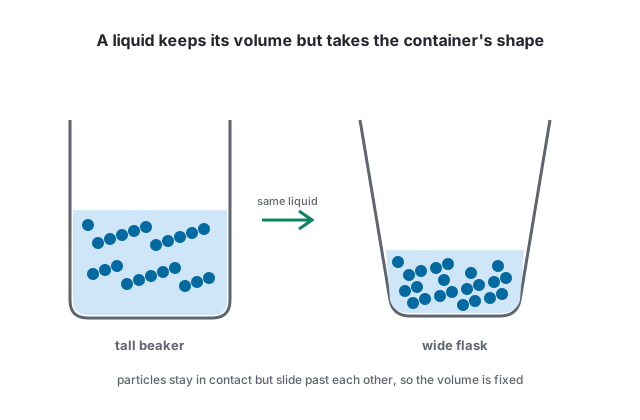
A liquid is a state of matter with a definite volume but no definite shape, so it flows and takes the shape of its container while filling it from the bottom up. Its particles stay close enough to resist compression yet loose enough to slide past one another, which is what allows flow.
In more detail
A liquid holds its volume but not its shape. Pour 100 mL of water into a beaker, a flask, or a jar and you still have 100 mL, shaped differently each time.
Why does a liquid keep its volume but not its shape?
In a solid, particles vibrate around fixed positions in an ordered lattice. In a gas, almost nothing holds them together. A liquid sits between the two.
Intermolecular forces, the attractions between particles, are strong enough to hold particles in contact, so a liquid cannot spread out to fill a container like a gas. They are too weak to fix particles in position, so layers slide over one another and the liquid flows and takes the container's shape from the bottom up.
Very little empty space is left between particles, which is why liquids are nearly incompressible: a sealed syringe of water barely compresses, while one full of air collapses.
What makes one liquid thicker than another?
Viscosity measures how strongly a liquid resists flowing, and it depends on how tightly the particles grip one another. Water at 20 degrees Celsius has a viscosity near 1 millipascal second. Olive oil is tens of times higher and honey thousands of times higher, which is why honey crawls off a spoon. Heating thins almost any liquid, because faster particles slip past their neighbors more easily.
Why does water bead up and curve in a graduated cylinder?
Two attractions compete. Cohesion pulls a liquid's particles toward each other; adhesion pulls them toward a different surface. Surface tension comes from cohesion at the top: a molecule in the bulk is pulled evenly in every direction, but one at the surface has no neighbors above, so the net pull is inward and the surface acts like a stretched skin.
Water reaches about 72 millinewtons per meter at 20 degrees Celsius, high for a liquid because of hydrogen bonding, which is why raindrops pull into spheres and a paperclip can float.
When adhesion wins, the liquid climbs the wall, and in a narrow tube it drags the column with it. That is capillary action, and the narrower the tube, the higher the rise. The same contest sets the meniscus: water sticks to glass better than to itself, so it climbs the walls and dips in the middle, giving a concave meniscus you read at the bottom of the curve.
Mercury holds itself together more tightly than it sticks to glass, so it bulges upward and is read at the top.
What is the difference between evaporation and boiling?
Both turn liquid into gas, but by different routes. Particles in a liquid do not all carry the same energy, so at any temperature a few at the surface are fast enough to escape. That is evaporation: surface only, at any temperature, and cooling, because the fastest particles are the ones that leave.
Boiling happens throughout the liquid and only at one temperature. Escaped particles above the surface exert a vapor pressure that climbs as the liquid warms. Boiling starts when the vapor pressure equals the pressure pushing down from outside, so bubbles can survive inside the liquid instead of collapsing.
Water's vapor pressure is about 2.3 kPa at 20 degrees Celsius and 101.3 kPa at 100 degrees Celsius, its boiling point at sea level. Lower the outside pressure and the boiling point falls with it: at about 84 kPa, the pressure near 1600 meters of elevation, water boils near 95 degrees Celsius.
Where do melting and freezing points fit?
They are the same temperature reached from opposite directions. For a pure substance at fixed pressure, the solid's melting point and the liquid's freezing point are identical, and for water at 1 atm both are 0 degrees Celsius. Energy added at a phase boundary breaks attractions instead of raising temperature, so ice water stays at 0 degrees Celsius until the last ice melts.
Melting ice needs 334 joules per gram; boiling water needs 2260 joules per gram, because escaping as a gas means leaving every neighbor behind.
Why does ice float on liquid water?
Density is mass divided by volume, quoted in grams per milliliter for liquids. Take 250 mL of ethanol at 0.789 g/mL: its mass is 250 x 0.789 = 197 g, less than an equal volume of water.
Nearly every substance is denser as a solid, because cooling packs particles closer together. Water is the famous exception. Its molecules form hydrogen bonds at fixed angles, so on freezing they lock into an open hexagonal pattern with gaps built in.
Ice has a density near 0.917 g/mL, while liquid water peaks at 1.000 g/mL around 4 degrees Celsius. Freeze 1000 g of water and the volume goes from about 1000 mL to 1000 / 0.917 = 1091 mL, an expansion of roughly 9 percent. Ice cubes float, pipes split in a freeze, and lakes freeze top down, leaving liquid water underneath.
Which liquids mix, and which separate?
Miscible liquids dissolve in each other in any proportion, like ethanol and water. Immiscible ones separate into layers, like oil and water. Like dissolves like: polar mixes with polar, nonpolar with nonpolar.
Ethanol can hydrogen bond with water, while nonpolar oil molecules cannot break into water's hydrogen bonded network. When two liquids do separate, density sets the order, so vegetable oil near 0.92 g/mL sits on top of water at 1.00 g/mL.
Key facts
| Field | General Chemistry |
|---|---|
| Volume | Definite and easily measurable |
| Shape | Indefinite; conforms to the container |
| Particle arrangement | Close together but free to slide past one another |
| Compressibility | Nearly incompressible under ordinary pressure |
| Surface tension of water | About 72 mN/m at 20 degrees Celsius |
| Viscosity of water | About 1 mPa s at 20 degrees Celsius |
| Density of ice vs water | 0.917 g/mL vs 1.000 g/mL, so ice floats |
| Phase boundaries | Freezes into a solid below; boils into a gas above |
Measure 50.0 mL of water in a graduated cylinder and you read the bottom of the curved meniscus at eye level, because water climbs the glass wall. Pour that water into a round flask and the surface reshapes itself to the new container, yet the volume is still 50.0 mL. Squeeze the flask and almost nothing happens: the particles are already touching, so there is no empty space to close.
Frequently asked questions
What is the difference between evaporation and boiling?
Evaporation happens only at the surface and at any temperature, when the fastest particles escape into the air. Boiling happens throughout the liquid and only when the vapor pressure equals the outside pressure, which lets bubbles form inside the liquid. Evaporation cools what stays behind, because the highest energy particles are the ones that leave.
Are liquids completely incompressible?
They are treated as incompressible in most chemistry problems, and that assumption works well. In reality liquids compress a very small amount under extreme pressure, since the particles are already in contact and there is almost no empty space to close. Gases, by contrast, are mostly empty space and compress easily.
Why does water form a concave meniscus while mercury forms a convex one?
It comes down to adhesion versus cohesion. Water sticks to glass more strongly than it sticks to itself, so it climbs the walls and the center dips, giving a concave curve you read at the bottom. Mercury holds itself together far more strongly than it sticks to glass, so it pulls away from the walls and bulges upward, and you read it at the top.
Why does ice float on liquid water?
Because ice is less dense than the liquid it came from, at about 0.917 g/mL against 1.000 g/mL. Hydrogen bonds form at fixed angles, so freezing locks water molecules into an open hexagonal structure with built in gaps. Freezing 1000 g of water expands its volume to about 1091 mL, roughly 9 percent more, which is also why pipes split in a hard freeze.
How does heating a liquid affect its viscosity?
Heating lowers viscosity, so the liquid flows more easily. Extra kinetic energy lets particles break away from their neighbors instead of dragging against them, which is why warm syrup pours faster than cold syrup. The effect is large for thick liquids like oils and honey and smaller for thin ones like water.
Why do oil and water separate instead of mixing?
Water molecules are polar and hydrogen bond strongly with each other, while oil molecules are nonpolar and cannot join that network. Pushing oil into water would cost more energy than it releases, so the two settle into layers, which makes them immiscible. Density decides the order, and oil near 0.92 g/mL floats on water at 1.00 g/mL.
Is the freezing point the same as the melting point?
For a pure substance at a fixed pressure, yes. Both describe the same solid to liquid boundary, just approached from different directions, and water sits at 0 degrees Celsius at 1 atm. The names differ only by which way the change is going. Impurities lower and broaden that boundary, which is why salted roads stay wet below 0 degrees Celsius.
Why do liquids have surface tension?
A molecule inside the liquid is pulled in every direction by its neighbors, so the forces cancel. A molecule at the surface has no neighbors above it, so the net pull is inward and the surface contracts into the smallest area it can. That inward pull acts like a thin elastic skin, strong enough in water to support a paperclip laid flat.