Cation
Definition and meaning of Cation in chemistry.
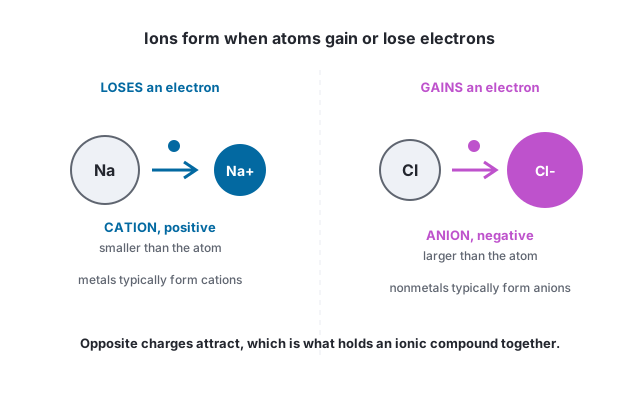
A cation is an ion with a positive charge, formed when an atom or group of atoms loses one or more electrons. Because protons then outnumber electrons, the net charge is positive. Metals form cations most readily, giving ions such as sodium, Na+, magnesium, Mg2+, and aluminum, Al3+. The proton count itself never changes.
In more detail
A cation is what an atom becomes after it gives an electron away. Start with neutral sodium, which has 11 protons and 11 electrons in perfect balance. Strip off the single outer electron and those 11 protons now face only 10 electrons, leaving one unit of positive charge.
The symbol is Na+. Lose two electrons instead and the charge is 2+, as in Mg2+. The nucleus is never touched, which is the detail that trips people up. A cation is positive because it is short of electrons, not because it gained protons.
Why do metals lose electrons so readily?
Because their outer electrons are loosely held, and losing them leaves a stable arrangement. Ionization energy measures the cost, meaning the energy needed to pull an electron off a gaseous atom. Sodium's first ionization energy is about 496 kJ per mole, which is modest.
Its second is about 4562 kJ per mole, roughly nine times higher, because that electron would have to come out of a full inner shell matching neon. The size of that jump is why sodium forms Na+ and stops there. Magnesium holds two loosely bound outer electrons, so it loses both and stops at Mg2+.
Which elements form cations, and with what charge?
Metals, on the left and center of the periodic table. Group 1 loses one electron and forms 1+ ions such as Li+, Na+, and K+. Group 2 loses two and forms 2+ ions such as Mg2+ and Ca2+.
Aluminum, in group 13, forms Al3+. For main-group metals the charge equals the group number, or that number minus 10 from group 13 on. Transition metals break the pattern, because their outer electrons sit close in energy to the shell beneath, so many form more than one cation.
Iron gives Fe2+ and Fe3+, and copper gives Cu+ and Cu2+. Zinc and silver are dependable exceptions, always Zn2+ and Ag+.
Why is a cation smaller than its parent atom?
Two effects push the same way. Fewer electrons repel one another less, so the cloud contracts, and the unchanged nuclear charge now pulls on fewer electrons, tightening its grip on each. Often the atom loses its whole outer shell, so the ion is a full shell smaller.
The change is dramatic. A sodium atom has a radius near 186 picometers, while a sodium ion measures about 102 picometers, a little over half as wide. Compare any metal atom with its cation and the ion is smaller.
How do you name a cation that has more than one possible charge?
With a Roman numeral in parentheses giving the charge, a system called Stock nomenclature. Iron(II) means Fe2+ and iron(III) means Fe3+, so FeCl2 is iron(II) chloride and FeCl3 is iron(III) chloride. When the numeral is not given, read the charge off the formula.
In Fe2O3 the three oxide ions carry 6- between them, so the two iron ions must carry 6+, which is 3+ each, making the compound iron(III) oxide. Metals with only one common charge need no numeral, so NaCl is just sodium chloride. Older names used the endings -ous and -ic for the lower and higher charge, as in ferrous and ferric.
Are there polyatomic cations?
Yes, though far fewer than there are polyatomic anions. Ammonium, NH4+, is a nitrogen atom bonded to four hydrogens, carrying a single positive charge across the group, and it acts like a metal ion in compounds such as ammonium chloride, NH4Cl. Hydronium, H3O+, is what a hydrogen ion actually becomes in water, since a bare proton attaches to a water molecule at once.
A rarer case is mercury(I), which exists as Hg2 2+, two mercury atoms bonded together and sharing a 2+ charge.
Why is it called a cation?
The name comes from the cathode. In electrolysis, positive ions drift toward the negative electrode, the cathode, and the word cation comes from Greek roots meaning going down. At the cathode each cation collects electrons and is reduced, which is how molten sodium chloride yields sodium metal.
Watch the wording here. The cathode is the negative electrode during electrolysis but the positive one in a battery. The definition that always holds is that reduction happens at the cathode.
How do cations and anions build a neutral compound?
The total positive charge must cancel the total negative charge, so use the least common multiple of the two. Calcium forms Ca2+ and phosphate is PO4 3-. The smallest number both 2 and 3 divide into is 6, so you need three calcium ions, 3 x 2+ = 6+, and two phosphate ions, 2 x 3- = 6-.
The formula is Ca3(PO4)2, a compound closely related to the mineral that hardens bone. A polyatomic ion taken more than once goes inside parentheses.
Where do cations show up in everyday life?
Everywhere, and especially in biology. Nerve cells run on sodium and potassium ions, and a pump in every cell membrane pushes 3 Na+ out for every 2 K+ it brings in, holding a voltage across the membrane. Calcium ions trigger muscle contraction and harden bone as a calcium phosphate mineral.
Magnesium ions sit at the center of every chlorophyll molecule, and iron ions carry oxygen inside hemoglobin. Hard water is water carrying dissolved Ca2+ and Mg2+, which react with soap to make scum and leave limescale in a kettle.
Key facts
| Field | General Chemistry |
|---|---|
| Electrical charge | Positive, usually 1+, 2+, or 3+ |
| How it forms | A neutral atom or group loses one or more electrons |
| Typical elements | Metals, especially groups 1 and 2 and the transition metals |
| Size vs parent atom | Smaller, since fewer electrons feel the same nuclear pull |
| Naming rule | Element name, plus a Roman numeral when the charge can vary |
| Common monatomic cations | Na+, K+, Mg2+, Ca2+, Al3+, Fe2+, Fe3+ |
| Common polyatomic cations | Ammonium, NH4+, and hydronium, H3O+ |
| Moves toward | The cathode during electrolysis, which gives the ion its name |
Sprinkle a little table salt into a gas flame and the flame burns bright yellow. The color comes from sodium's electrons. Heat lifts them into higher energy levels, and they release that energy as yellow light when they drop back down. Each metal gives its own color, so lithium burns crimson, potassium lilac, and calcium orange-red. Analysts use this flame test to work out which cation a sample contains.
Frequently asked questions
What is the difference between a cation and an anion?
A cation has lost electrons and carries a positive charge, while an anion has gained electrons and carries a negative one. Cations come mostly from metals and anions mostly from nonmetals. Cations are smaller than their parent atoms and anions are larger. In electrolysis cations travel to the cathode and anions to the anode.
Why is a cation smaller than the atom it came from?
Removing electrons leaves fewer of them to repel one another, and the same number of protons now pulls on a smaller group, so the electron cloud contracts. Metals often lose an entire outer shell, which shrinks the ion further. A sodium atom has a radius near 186 picometers, while a sodium ion is about 102 picometers.
How can I remember that a cation is the positive one?
Look at the letter t in cation, which can be read as a plus sign. Many students also use the phrase that a cat has paws, so a cation is pawsitive. Whichever trick you use, the chemistry behind it is that losing negatively charged electrons leaves a net positive charge.
Why does iron need a Roman numeral but sodium does not?
Iron forms more than one stable cation, Fe2+ and Fe3+, so the name has to say which one is present, giving iron(II) and iron(III). Sodium only ever forms Na+, so there is nothing to distinguish and no numeral is used. The same rule applies to most transition metals, along with tin and lead.
Can nonmetals form cations?
Yes, though it is much less common. Hydrogen forms H+, which exists in water as the hydronium ion, H3O+. Groups of nonmetal atoms can also carry a positive charge, as ammonium, NH4+, does. Most nonmetals still prefer to gain electrons and become anions instead.
Does an atom gain protons when it becomes a cation?
No. The number of protons in the nucleus fixes the element's identity and never changes in a chemical reaction. A cation is positive only because electrons have left, so the protons that were already there are no longer fully balanced. Sodium metal and the sodium ion both have exactly 11 protons.
Do cations move toward the anode or the cathode?
Cations move toward the cathode, which is where their name comes from. In electrolysis the cathode is the negative electrode, so it attracts positive ions and hands them electrons. Avoid memorizing the cathode as negative, since it is the positive terminal in a battery. Reduction always happens at the cathode.
How do you write the formula of an ionic compound from its ions?
Balance the charges so the compound comes out neutral. Sodium is Na+ and sulfide is S2-, so two sodium ions are needed for every sulfide ion, giving Na2S. When the charges do not divide evenly, use the least common multiple, which turns Ca2+ and PO4 3- into Ca3(PO4)2.