Anion
Definition and meaning of Anion in chemistry.
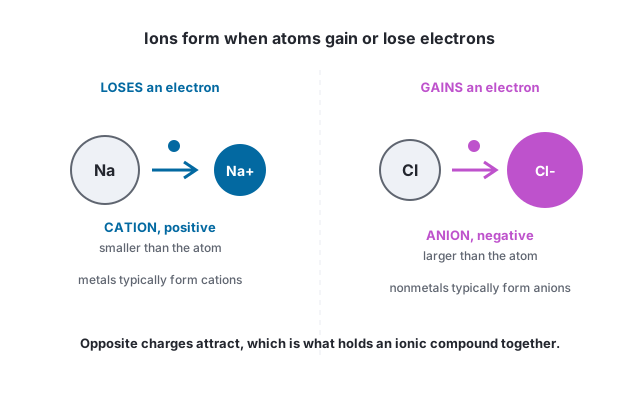
An anion is an ion with a negative charge, formed when an atom or group of atoms gains one or more electrons. The extra electrons make the electron count exceed the proton count, so the net charge is negative. Nonmetals such as chlorine and oxygen form anions, giving chloride, Cl-, and oxide, O2-.
In more detail
Charge is just bookkeeping. A neutral atom holds exactly as many electrons as protons, so the two cancel and the atom has no overall charge. Give it one extra electron and the balance tips.
The nucleus is untouched, but the cloud now holds one more negative charge, so the particle is 1-. Two extra electrons make it 2-. Notice what never changes: the proton count. A chloride ion is still chlorine, just chlorine carrying a passenger.
Why do atoms gain electrons at all?
For stability. An atom is most stable when its outer shell is full, matching the nearest noble gas. Chlorine has 17 electrons, seven of them in the outer shell, one short of the eight in argon.
Taking in one electron completes that shell, so chlorine becomes Cl- easily. The energy figures agree. Electron affinity is the energy released when a gaseous atom picks up an electron, and chlorine releases about 349 kJ per mole, the largest release of any element.
Fluorine is more electronegative yet gives back slightly less, about 328 kJ per mole, because its small outer shell crowds the incoming electron.
Not every anion is downhill energetically. Oxygen releases about 141 kJ per mole when it takes its first electron, but forcing a second onto the negative O- ion costs close to 800 kJ per mole. Isolated O2- ions therefore do not survive.
They exist inside solids such as magnesium oxide, where the energy of packing ions into a crystal lattice pays that bill.
Which elements form anions, and what charge do they take?
Nonmetals, on the right side of the periodic table. Group 17, the halogens, need one electron and form 1- ions: fluoride, chloride, bromide, iodide. Group 16 needs two and forms 2- ions such as oxide and sulfide.
Group 15 needs three, giving nitride and phosphide. One rule covers all three: the charge equals the group number minus 18. Group 18, the noble gases, already have full shells and form no anions.
The pull weakens down a group too, since the outer shell sits farther from the nucleus, so iodide forms less eagerly than fluoride. Hydrogen is the exception worth knowing. It usually loses its electron, but with a reactive metal it gains one and becomes the hydride ion, H-, as in sodium hydride, NaH.
How are anions named?
Take the stem of the element name and add the ending -ide. Chlorine gives chloride, oxygen gives oxide, sulfur gives sulfide, nitrogen gives nitride, phosphorus gives phosphide, carbon gives carbide, and hydrogen gives hydride. In a compound the positive ion comes first and keeps its element name, so NaCl is sodium chloride and Li3N is lithium nitride.
Why is an anion larger than its parent atom?
This one is tested constantly. Gaining an electron does nothing to the nucleus, so the same positive pull is now shared among more electrons. Each electron feels a weaker grip, and the added electron-electron repulsion pushes the cloud outward. A chlorine atom has a radius near 99 picometers, while a chloride ion measures about 181 picometers, nearly double.
The same idea sorts isoelectronic ions, which are ions with identical electron counts. O2-, F-, Na+ and Mg2+ each hold 10 electrons, and their radii fall in that order: roughly 140, 133, 102 and 72 picometers. More protons tugging on the same 10 electrons means a smaller ion, so anions sit at the large end.
What are polyatomic anions?
A negative charge does not have to sit on one atom. A polyatomic anion is a group of bonded atoms that carries a negative charge across the whole group. Five of them appear again and again: sulfate, SO4 2-; nitrate, NO3 -; carbonate, CO3 2-; phosphate, PO4 3-; and hydroxide, OH -.
The endings carry information. An -ate name holds more oxygen atoms than the matching -ite name at the same charge, so sulfate is SO4 2- while sulfite is SO3 2-, and nitrate is NO3 - while nitrite is NO2 -. Adding a hydrogen atom cancels one unit of negative charge, turning carbonate, CO3 2-, into hydrogen carbonate, HCO3 -, the ion in baking soda.
Why is it called an anion?
The name comes from electrolysis. Pass a current through molten salt or a solution and the ions drift toward opposite electrodes. Negative ions travel toward the anode, which is how they earned the name anion, built from Greek roots meaning going up.
On reaching the anode an anion hands over its extra electrons, and that loss of electrons is oxidation. One caution about wording: the anode is the positive electrode during electrolysis but the negative one in a battery. The definition that always holds is that the anode is the electrode where oxidation occurs.
How do anions balance charge in ionic compounds?
An ionic compound carries no overall charge, so positive and negative totals must cancel. Find the least common multiple of the two charges. Aluminum forms Al3+ and oxygen forms O2-, and the smallest number both 3 and 2 divide into is 6.
Two aluminum ions supply 2 x 3+ = 6+, three oxide ions supply 3 x 2- = 6-, and the formula is Al2O3. Magnesium chloride is quicker: one Mg2+ at 2+ needs two Cl- at 1- each, so the formula is MgCl2.
Key facts
| Field | General Chemistry |
|---|---|
| Electrical charge | Negative, usually 1-, 2-, or 3- |
| How it forms | A neutral atom or group gains one or more electrons |
| Typical elements | Nonmetals, especially groups 15, 16, and 17 |
| Charge rule | Group number minus 18, so group 17 gives 1- and group 16 gives 2- |
| Size vs parent atom | Larger, because added electrons increase repulsion |
| Naming rule | Element stem plus -ide, as in chloride, oxide, and nitride |
| Common polyatomic anions | SO4 2-, NO3 -, CO3 2-, PO4 3-, OH - |
| Moves toward | The anode during electrolysis, which gives the ion its name |
Add a few drops of silver nitrate solution to tap water and a faint white cloud appears. That cloud is silver chloride, formed because chloride anions in the water meet silver cations and lock into a solid that will not dissolve. Chemists use this exact test to show that an unknown solution contains chloride. Bromide gives a cream precipitate and iodide a pale yellow one, so the anion announces itself by color.
Frequently asked questions
What is the difference between an anion and a cation?
An anion has gained electrons and carries a negative charge, while a cation has lost electrons and carries a positive one. Anions come mostly from nonmetals and cations mostly from metals. During electrolysis anions move toward the anode and cations toward the cathode. Because their charges are opposite, the two attract and combine into ionic compounds.
Why is an anion bigger than the atom it came from?
The nucleus keeps the same number of protons, but there are now more electrons sharing that pull, so each electron is held less tightly. The extra repulsion between electrons also pushes the cloud outward. A chlorine atom has a radius near 99 picometers, while a chloride ion is about 181 picometers, close to double.
How do you predict the charge on an anion?
Use the group number of the element and subtract 18. Group 17 elements gain one electron and form 1- ions, group 16 gains two and forms 2- ions, and group 15 gains three and forms 3- ions. Group 18 already has a full outer shell, so noble gases do not form anions.
Why do anion names end in -ide?
The -ide ending is the naming convention for a monatomic anion, meaning an anion made of a single atom. You keep the stem of the element name and swap the ending, so oxygen becomes oxide and sulfur becomes sulfide. Anions made of several atoms usually end in -ate or -ite instead, as with sulfate and sulfite.
Is chloride the same thing as chlorine?
No. Chlorine is the neutral element, a toxic yellow-green gas made of Cl2 molecules. Chloride is the anion that forms when a chlorine atom gains one electron, written Cl-, and it is stable and harmless in table salt. The names differ by a single ending because the electron count differs by one.
Can a group of atoms act as one anion?
Yes, and those are called polyatomic anions. Sulfate, SO4 2-, nitrate, NO3 -, carbonate, CO3 2-, phosphate, PO4 3-, and hydroxide, OH -, each hold their atoms together with covalent bonds while the whole group carries the negative charge. They behave as single units in reactions and stay intact when their compounds dissolve.
Do anions move toward the anode or the cathode?
Anions move toward the anode, which is where the name comes from. In an electrolysis cell the anode is the positive electrode, so it attracts negative ions. Do not memorize anode as positive though, because in a battery the anode is negative. The rule that never fails is that oxidation happens at the anode.
Why do two anions never bond with each other?
Both carry a negative charge, and like charges repel, so two anions push each other apart. An anion needs a positively charged partner, a cation, to form an ionic bond. In a crystal such as sodium chloride the arrangement puts each anion next to cations and keeps anions as far from one another as possible.