Mica
Definition and meaning of Mica in chemistry.
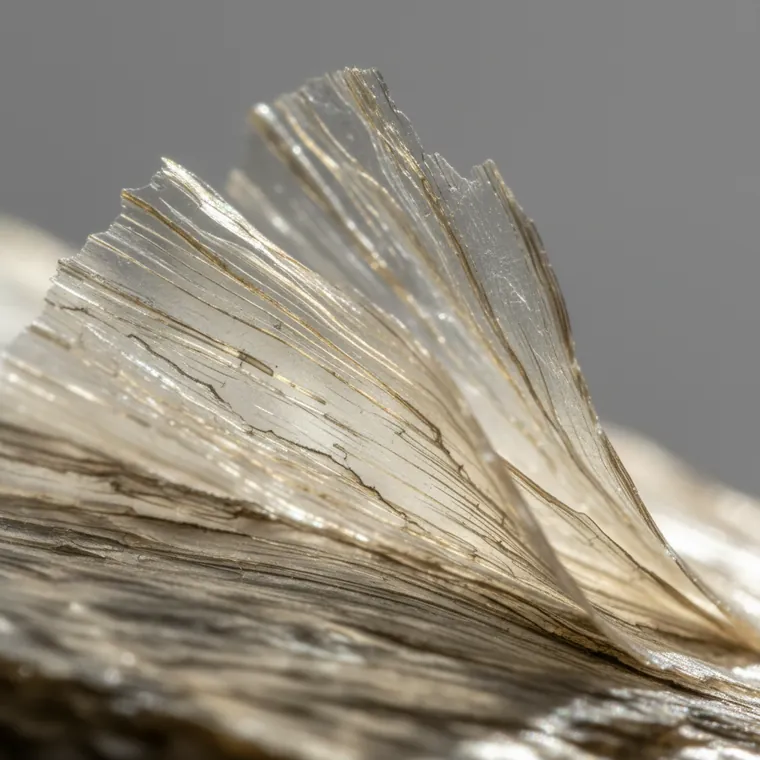
Mica is a group of silicate minerals known for their sheet-like crystal structure. This structure lets mica split easily into extremely thin, flexible flakes. Several related minerals, including muscovite and biotite, belong to the mica group.
In more detail
Chemically, micas are complex aluminosilicates that also contain varying amounts of potassium, magnesium, and iron. Their layered structure comes from hexagonal sheets of silica tetrahedra, small pyramid-shaped units of silicon and oxygen atoms bonded strongly within each sheet. These sheets stack on top of each other, but only weak van der Waals forces or weak ionic bonds hold adjacent sheets together.
Because the bonds within a sheet are far stronger than the bonds between sheets, mica cleaves easily along flat planes, producing thin, flexible flakes. Micas are chemically inert, lightweight, and resist heat and electricity extremely well. These properties make mica valuable in a wide range of industrial uses, from electrical insulation to cosmetic pigments that give products a shimmering appearance.
Mica forms naturally in igneous and metamorphic rocks, often crystallizing slowly as magma cools deep underground. Mica sheets can be cut extremely thin while still remaining an effective insulator. This makes them useful as viewing windows in high-temperature equipment like furnaces and wood stoves.
Mica is also chemically stable, resisting most acids and remaining unaffected by exposure to moisture or common solvents. Finely ground mica gives many cosmetic products, from eyeshadow to nail polish, their characteristic sparkle and shimmer. Sheet mica used in industry is graded by size and clarity, with the highest grades reserved for electronics and specialty optics.
Key facts
| Field | Inorganic Chemistry |
|---|---|
| Structure | Sheet silicate (phyllosilicate) |
| Formula (muscovite) | KAl2(AlSi3O10)(OH)2 |
| Common members | Muscovite, biotite, phlogopite |
| Key property | Splits easily into thin, flexible sheets |
Muscovite has the general formula KAl2(AlSi3O10)(OH)2. This transparent mica is commonly used as a high-temperature electrical insulator in electronic equipment, since it resists heat and does not conduct electricity.
Frequently asked questions
Why does mica so easily split into very thin sheets?
Its crystal structure consists of strong layers of silicate tetrahedra held together by much weaker forces between layers. This allows exceptionally easy physical cleavage parallel to the sheets.
What are the common industrial uses for mica?
It is widely used as a thermal and electrical insulator in capacitors and heating elements, and as a shimmering pigment in cosmetics.
Is mica the same in every rock it appears in?
No. Mica is a group of related minerals, not a single compound. Muscovite is usually clear or pale, while biotite contains more iron and magnesium and appears dark brown or black.
Sources & references
See our sources and editorial standards.