Ammonia
Definition and meaning of Ammonia in chemistry.
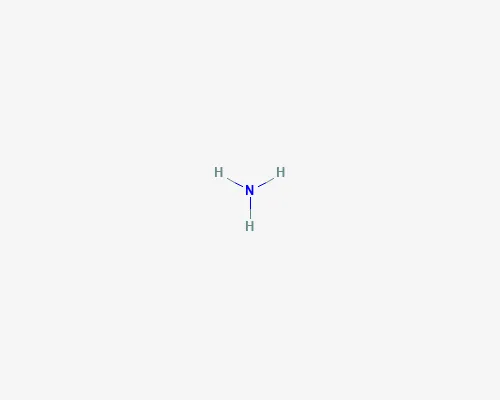
Ammonia is a colorless gas with a sharp, pungent smell, made of one nitrogen atom bonded to three hydrogen atoms. It dissolves easily in water and behaves as a weak base.
In more detail
Industry makes most of the world's ammonia through the Haber-Bosch process, which combines nitrogen gas from the air with hydrogen gas under high pressure and high temperature, using an iron catalyst to speed up the reaction. This single process produces well over one hundred million tons of ammonia every year, and most of it becomes nitrogen-based fertilizer that supports global food production.
When ammonia dissolves in water, it acts as a weak base. Only a small fraction of the dissolved ammonia molecules accept a proton from water to form ammonium ions and hydroxide ions, so the solution stays only mildly basic rather than strongly alkaline. Ammonia also plays a natural role in the nitrogen cycle.
Bacteria in soil and water produce ammonia through a process called ammonification, breaking down nitrogen-containing waste and dead organic matter and returning nitrogen to a form other organisms can use. Ammonia's sharp smell serves as a natural warning sign, since even low concentrations in air irritate the eyes and lungs, which is why it must be handled with proper ventilation in labs and industrial plants.
Liquid ammonia is also widely used as a refrigerant in large industrial cooling systems, since it absorbs a great deal of heat as it evaporates.
Key facts
| Chemical formula | NH3 |
|---|---|
| Field | Inorganic Chemistry |
| State at room temperature | Colorless gas with pungent odor |
| Primary industrial use | Nitrogen fertilizer production |
| Production method | Haber-Bosch process |
Dissolving ammonia gas in water creates aqueous ammonia, often labeled ammonia water or household ammonia. This solution is a common ingredient in glass and surface cleaners because it dissolves grease and other organic residues effectively without leaving streaks. Mixing ammonia cleaners with bleach is dangerous, since the two react to form toxic chloramine gas.
Frequently asked questions
Why is ammonia considered a weak base?
Ammonia is a weak base because in water it only partially ionizes to form ammonium ions (NH4+) and hydroxide ions (OH-), rather than completely dissociating like strong bases such as NaOH.
What is the Haber-Bosch process?
The Haber-Bosch process is the industrial method of making ammonia from atmospheric nitrogen (N2) and hydrogen (H2) using high temperature, high pressure, and an iron catalyst.
Is ammonia the same as ammonium?
No. Ammonia (NH3) is a neutral molecule, while ammonium (NH4+) is a positively charged ion formed when ammonia accepts a proton. Fertilizers often contain ammonium salts rather than ammonia gas itself.
Related terms
Sources & references
See our sources and editorial standards.