Solubility
Definition and meaning of Solubility in chemistry.
Solubility is the maximum amount of a substance that dissolves in a given amount of solvent at a stated temperature. It is usually reported as grams of solute per 100 grams of solvent, or as moles per liter. Once that limit is reached, the solution is saturated and no more solute will dissolve.
In more detail
A solubility figure means little on its own. Saying that sodium chloride is soluble in water is only half a statement. The full version is that roughly 36 g of sodium chloride dissolves in 100 g of water at 25 degrees Celsius .
Change the temperature and that number shifts. Change the solvent and it can fall to almost nothing. Chemists therefore quote solubility two ways: grams of solute per 100 g of solvent, or moles per liter of saturated solution, called molar solubility. A stated temperature always comes attached.
Saturated, unsaturated, and supersaturated
These three words describe how close a solution sits to its limit. An unsaturated solution holds less solute than it could, so adding more solid simply dissolves it. A saturated solution has reached the limit, and any extra solid settles out.
That leftover solid is not idle: particles keep leaving the crystal while others rejoin it at matching rates, a balance called dynamic equilibrium. A supersaturated solution is the odd one out, because it holds more dissolved solute than the limit should allow. You make one by saturating a hot solvent, then cooling it slowly without jostling the container.
The excess stays dissolved only because nothing has given it a place to start crystallizing. Drop in one seed crystal and the surplus solidifies within seconds, which is exactly how reusable sodium acetate hand warmers work.
What like dissolves like really means
Polarity decides what mixes with what. Water molecules are polar, with a slightly negative oxygen end and slightly positive hydrogen ends, so water dissolves ionic compounds and polar molecules such as sugar and ethanol. Nonpolar solvents such as hexane dissolve nonpolar solutes: fats, waxes, and iodine.
Oil and water separate because separating water molecules to fit a nonpolar guest costs more energy than the new arrangement returns. Similar intermolecular forces, good solubility.
Why does heat help most solids but drive gases out?
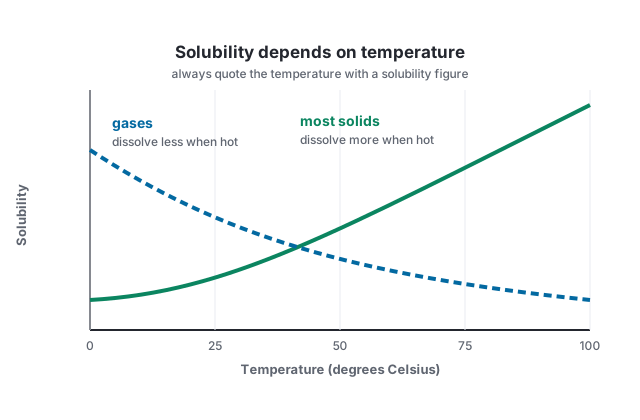
For most ionic and molecular solids, solubility climbs steeply with temperature. Potassium nitrate is the textbook case: about 13 g dissolves in 100 g of water at 0 degrees Celsius, and about 245 g at 100 degrees Celsius. The trend is not universal.
Sodium chloride barely budges, moving from roughly 36 g to about 39 g across that same range, and calcium hydroxide becomes less soluble as the water warms. Gases behave the opposite way in every ordinary case. Warming a liquid gives dissolved gas molecules enough kinetic energy to escape the surface, so hot water holds less oxygen or carbon dioxide than cold water.
Pressure matters for gases too, and only for gases. Henry's law states that the amount of gas dissolved is proportional to the partial pressure of that gas above the liquid, so doubling the pressure roughly doubles the dissolved amount. A sealed soda can is pressurized with carbon dioxide. Open it, the pressure drops, and the gas leaves.
Dissolving faster is not dissolving more
This is the distinction exam questions love. Stirring, crushing the solid into a powder, and heating the solvent all increase the rate of dissolving, because they bring solvent molecules into contact with fresh solid surface more often. Only two things change the amount that can dissolve: temperature, and for gases, pressure.
Stir a saturated salt solution for an hour and not one extra gram goes in. Powdered sugar dissolves faster than a sugar cube, but the same mass of water holds the same total sugar.
Solubility rules and predicting precipitates
Rather than memorize a full table, learn the rules that hold with few exceptions:
All nitrates are soluble, with no exceptions worth worrying about.
Almost all Group 1 salts (lithium, sodium, potassium) and all ammonium salts are soluble.
Most chlorides, bromides, and iodides are soluble, except those of silver and lead.
Most sulfates are soluble, except barium and lead sulfate. Calcium sulfate is only slightly soluble.
Most carbonates, phosphates, and hydroxides are insoluble, except the Group 1 and ammonium versions.
These rules let you predict a precipitate before you mix anything. Combine silver nitrate solution with sodium chloride solution and swap partners. Sodium nitrate stays dissolved, while silver chloride does not, so it appears as a white solid: AgNO3(aq) + NaCl(aq) -> AgCl(s) + NaNO3(aq).
Ksp, the college-level version
For a sparingly soluble ionic solid, solubility is described by an equilibrium constant called the solubility product, Ksp. Silver chloride dissolves as AgCl(s) -> Ag+(aq) + Cl-(aq), so Ksp = [Ag+][Cl-], which equals 1.8 x 10⁻¹⁰ at 25 degrees Celsius. If the molar solubility is s , then s2 = 1.8 x 10⁻¹⁰, giving s = 1.3 x 10⁻⁵ mol/L.
Multiply by the molar mass of 143.3 g/mol and you get about 0.002 g per liter. That is why insoluble really means very slightly soluble.
A worked example
Dissolve 90 g of potassium nitrate in 100 g of water at 100 degrees Celsius. The limit there is around 245 g, so the solution is unsaturated and all of it dissolves. Now cool the beaker to 20 degrees Celsius, where only about 32 g can stay dissolved in 100 g of water.
The water cannot hold the rest, so 90 minus 32, that is 58 g, crystallizes out. This is recrystallization, a standard way to purify a solid.
Key facts
| Field | Physical Chemistry |
|---|---|
| Standard units | Grams per 100 g of solvent, or mol/L (molar solubility) |
| Always state | The temperature, since a figure without one is meaningless |
| Guiding rule | Like dissolves like (polar dissolves polar) |
| Sodium chloride | About 36 g per 100 g of water at 25 degrees Celsius |
| Potassium nitrate | About 13 g per 100 g of water at 0 degrees Celsius, about 245 g at 100 degrees Celsius |
| Temperature effect | Most solids more soluble when hot; gases less soluble when hot |
| Pressure effect | Matters only for gases (Henry's law: dissolved amount is proportional to partial pressure) |
| Always soluble | Nitrates, Group 1 salts, and ammonium salts |
Stir a spoonful of sugar into iced tea and it lingers at the bottom for a long time. The same spoonful vanishes in a hot cup within seconds. Two separate effects are at work. Hot water dissolves sugar faster, and it also dissolves far more of it, since sucrose solubility more than doubles between room temperature and boiling. Let a hot saturated syrup cool slowly around a string and the surplus sugar grows back as rock candy.
Frequently asked questions
What is the difference between solubility and the rate of dissolving?
Solubility is how much solute can dissolve; rate is how quickly it gets there. Stirring, powdering the solid, and heating all speed up dissolving. Only temperature, plus pressure for gases, changes the maximum amount that will dissolve.
Does stirring increase solubility?
No. Stirring moves fresh solvent past the solid surface, so the solute dissolves faster, but the ceiling stays the same. Once a solution is saturated, you can stir all day and no further solid will go in.
Why are gases less soluble in hot water when most solids are more soluble?
Dissolving a gas releases energy, and warming a liquid gives the dissolved gas molecules enough kinetic energy to escape the surface. Most solids need energy input to break their lattice apart, so heat pushes that process forward instead. This is why warm soda goes flat and warm river water holds less dissolved oxygen.
What is the difference between saturated, unsaturated, and supersaturated?
An unsaturated solution can still dissolve more solute. A saturated solution is at its limit, with dissolving and crystallizing happening at equal rates. A supersaturated solution temporarily holds more than the limit, and it dumps the excess as solid the moment a seed crystal or a scratch gives crystals somewhere to form.
Does insoluble mean nothing dissolves at all?
No. Almost every solid dissolves a little. Chemists usually call a compound insoluble when less than about 0.1 g dissolves per 100 mL of water. Silver chloride is called insoluble, yet roughly 0.002 g of it dissolves in a liter of water at room temperature.
How do solubility rules predict a precipitate?
Write down the ions present after mixing, then pair each cation with the other solution's anion. Check each new pairing against the rules. If one combination is insoluble, that compound forms as a precipitate while the other ions stay dissolved as spectator ions.
What does Ksp tell you that a solubility table does not?
Ksp is an equilibrium constant, so it works even when other ions are already present. It lets you predict whether a precipitate will form in a mixture by comparing the ion product with Ksp, and it explains the common ion effect, where adding a shared ion pushes solubility down.
Why does oil not dissolve in water?
Oil molecules are nonpolar and water molecules are polar. Water molecules hold onto each other through hydrogen bonding, and separating them to surround an oil molecule costs more energy than the weak new attractions return. The two liquids therefore stay in separate layers.