Oil
Definition and meaning of Oil in chemistry.
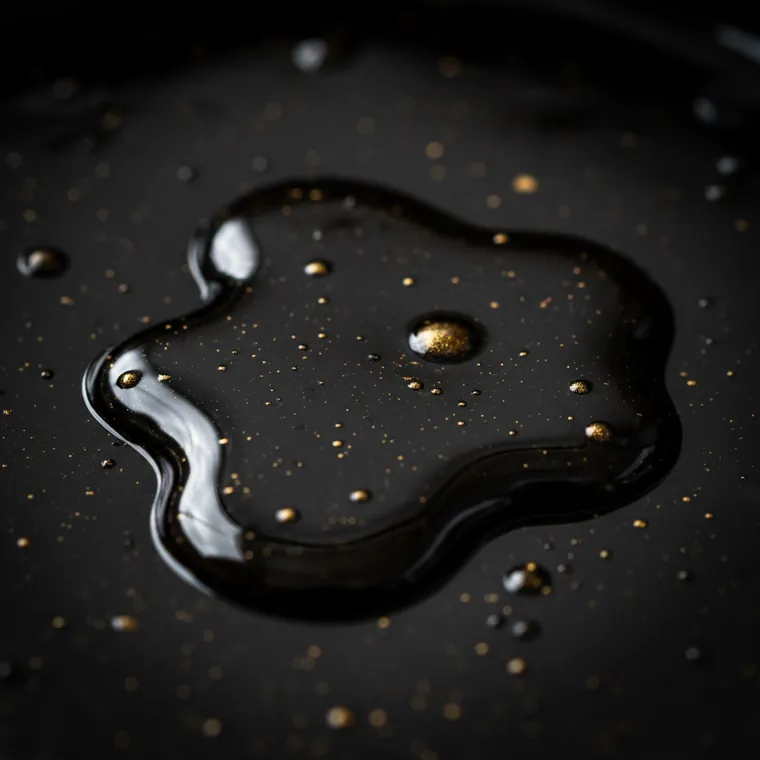
Oil is a nonpolar organic liquid made mostly of carbon and hydrogen. It is hydrophobic, meaning it repels water. Oils usually contain long hydrocarbon chains or complex triglyceride molecules.
In more detail
In chemistry, we focus on the specific molecular structure of oils. Oils come from either mineral sources or biological sources. Mineral oils come from crude petroleum found underground.
They are complex mixtures of simple hydrocarbon chains called alkanes. Vegetable oils come from plants and animals. They are large molecules called triglycerides.
A triglyceride is an ester formed by linking one glycerol molecule to three fatty acid chains. The carbon chains in these fatty acids can be saturated or unsaturated. Saturated chains have only single bonds between carbon atoms.
Unsaturated chains contain at least one double bond. The most defining chemical feature of all oils is their nonpolar nature. They lack the partial electrical charges found in water molecules.
Because water is highly polar, oil and water cannot mix. Instead, oil forms a separate layer on top of water because it is less dense. Oils dissolve readily in other nonpolar solvents like hexane.
This behavior perfectly illustrates the chemical rule that like dissolves like. Students often confuse melting point with polarity. Oils are liquid at room temperature simply because their molecules cannot pack tightly together. This is especially true for unsaturated vegetable oils with bent hydrocarbon chains.
Key facts
| Field | Organic Chemistry |
|---|---|
| Solubility in water | Immiscible (nonpolar) |
| Density | Less dense than water |
| Mineral oil composition | Long-chain alkanes and cyclic hydrocarbons |
| Biological oil composition | Triglycerides (glycerol esters of fatty acids) |
| Physical state | Liquid at room temperature |
Olive oil is a common biological oil found in kitchens. Its main chemical component is a molecule called triolein. Triolein is a triglyceride formed by linking three oleic acid molecules to a single glycerol backbone. Oleic acid is an unsaturated fatty acid. It has a specific double bond that creates a bend in its hydrocarbon chain. This bend prevents the molecules from packing tightly. That is why olive oil remains a liquid at room temperature instead of freezing solid.
Frequently asked questions
Why don't oils mix with water?
Oil molecules are nonpolar and hydrophobic. Water molecules are polar and hydrophilic. The chemical rule "like dissolves like" explains why they separate into two layers.
What is the difference between mineral oils and vegetable oils?
Vegetable oils are triglycerides made by plants. Mineral oils are complex hydrocarbon mixtures pumped from underground crude petroleum.
Why are some oils healthier to eat than others?
Health effects depend on the chemical bonds in the fatty acid chains. Oils with unsaturated carbon-carbon double bonds are generally considered healthier than highly saturated fats.