Matter
Definition and meaning of Matter in chemistry.
Matter is anything that has mass and takes up space, meaning it occupies a measurable volume. Every physical substance in the universe, from the air in a room to the water in a glass, counts as matter. Light, heat, and sound do not, because they carry energy without mass or volume.
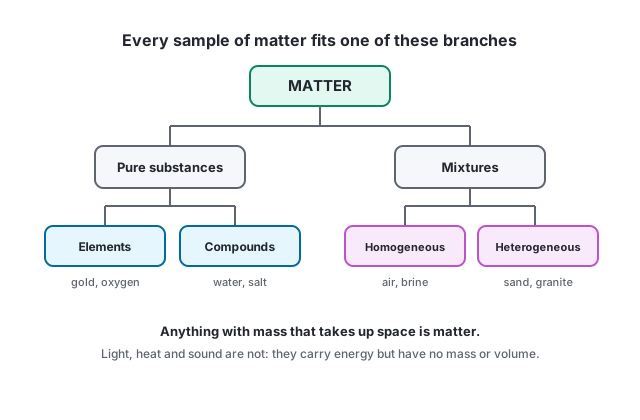
In more detail
Everything you can weigh and everything that takes up room counts as matter. That gives you a two-part test: does the sample have mass, and does it occupy volume? A cup of water passes easily.
So does the air inside a balloon, even though you cannot see it. One liter of air at room temperature has a mass of about 1.2 grams.
Why are light, heat, and sound not matter?
None of them passes the two-part test. Light is a stream of photons with zero rest mass, so it cannot be weighed. Heat is energy moving between objects, not a substance that pours into them.
Sound is a pressure wave traveling through matter, so it needs matter to exist but is not matter itself. Gravity, magnetic fields, and ideas fail the same test. When you are unsure, ask whether the thing could sit on a balance and fill a measuring cylinder.
What is the difference between mass and weight?
Mass measures how much matter an object contains, and it stays the same everywhere. Weight is the force gravity exerts on that mass, so it changes when gravity changes: weight = mass x gravitational field strength.
Try it with numbers. A student with a mass of 60.0 kg stands on Earth, where g is 9.81 m/s^2, so her weight is 60.0 x 9.81 = 589 newtons. On the Moon, where g is 1.62 m/s^2, her weight is 60.0 x 1.62 = 97.2 newtons.
She still contains 60.0 kg of matter. Only the pull changed, by a factor of about 6. Bathroom scales read in kilograms, which is why the words blur together in everyday speech.
What does the particle model say about matter?
All matter is built from particles, atoms, ions, or molecules, that move constantly and attract one another. Temperature measures the average kinetic energy of that motion. There is space between particles, so gases compress.
The motion is random, so a drop of dye spreads through still water with no stirring. Adding energy weakens the attractions, which is what drives a change of state.
What are the states of matter?
Solids hold both shape and volume, liquids hold volume but take the container's shape, and gases fill whatever contains them. Plasma, an ionized gas, is usually counted as the fourth state. Water is still water as ice, liquid, or steam, because the molecules themselves do not change.
How do chemists classify matter?
Start with one question: is this one substance or several mixed together? Pure substances have a fixed composition throughout and divide into elements and compounds. An element cannot be broken into anything simpler by chemical means, such as copper, helium, or sulfur.
A compound is two or more elements bonded in a fixed ratio, such as water (H2O) or table salt (NaCl).
Mixtures hold two or more substances that keep their own identities. A homogeneous mixture, also called a solution, looks uniform throughout: salt water, clean air, brass. A heterogeneous mixture has parts you can pick out: sand in water, granite, oil and vinegar dressing.
Physical methods such as filtering, distilling, or evaporating separate mixtures, but only a chemical reaction breaks up a compound.
Which properties describe matter?
A physical property can be measured without changing what the substance is: density, color, melting point, boiling point, hardness, conductivity, solubility. A chemical property only shows up when the substance turns into something else: flammability, reactivity with acid, or the tendency to rust. Properties split another way too.
Intensive properties like density and melting point ignore sample size, while extensive properties like mass and volume depend on it.
How can you tell a physical change from a chemical change?
Ask whether new substances were made. Melting ice, dissolving sugar, and tearing paper are physical: the same particles are simply moved around. In a chemical change, bonds break and form, so the products have new properties.
Four clues point to a chemical change: an unexpected color change, a gas released from something that is not boiling, a solid precipitate appearing when two clear solutions meet, and heat or light given off or taken in. Treat them as hints, not proof. Boiling water releases gas too, and that change is purely physical.
Is mass always conserved?
In ordinary chemistry, yes. The law of conservation of mass says the total mass of a closed system stays constant, because a reaction only rearranges atoms.
Here is the balance for burning magnesium, 2Mg + O2 -> 2MgO. Take 4.86 g of magnesium, which is 4.86 / 24.3 = 0.200 mol. That needs 0.100 mol of oxygen gas, or 0.100 x 32.00 = 3.20 g, and it yields 0.200 mol of magnesium oxide at 40.3 g/mol, which is 0.200 x 40.3 = 8.06 g.
In: 4.86 + 3.20 = 8.06 g. Out: 8.06 g. Nothing is missing.
This also explains why magnesium seems to gain mass in an open crucible while wood seems to lose it. The oxygen taken in and the gases lost were never weighed.
Nuclear reactions are the real exception. In fission and fusion a measurable share of mass converts into energy through E = mc^2, so mass by itself is not conserved; mass and energy together are. Chemical reactions do this too, but the amount is far too small to see. A reaction releasing 500 kJ loses roughly 5.6 x 10^-9 g.
Key facts
| Field | General Chemistry |
|---|---|
| Defining test | Has mass and occupies volume |
| Building blocks | Atoms, ions, and molecules |
| Common states | Solid, liquid, gas, plasma |
| Main classes | Pure substances (elements, compounds) and mixtures (homogeneous, heterogeneous) |
| Not matter | Light, heat, sound, and other forms of energy |
| Mass vs weight | Mass is fixed; weight depends on local gravity |
| Conservation law | Total mass of a closed system stays constant |
| Edge case | Nuclear reactions convert mass to energy via E = mc^2 |
Set a sealed plastic bottle holding baking soda and vinegar on a balance and record its mass. Mix them and the bottle fizzes hard, but the reading does not move: the carbon dioxide is still matter, still inside, still weighed. Loosen the cap and the gas escapes, and the balance now reads lower. Nothing vanished. The matter simply left the system.
Frequently asked questions
Is light considered a form of matter?
No. Light is made of photons, which have zero rest mass and occupy no volume of their own, so it fails both halves of the test for matter. Light is a form of energy that travels through space and through matter. It can be absorbed by matter and can push on it, but it is not matter.
Is air matter if you cannot see it?
Yes. Air is a mixture of gases, mostly nitrogen and oxygen, and those molecules have mass and take up space. One liter of air at room temperature has a mass of roughly 1.2 grams, which a sensitive balance detects easily. Invisibility has nothing to do with whether something is matter.
What is the difference between mass and weight?
Mass is the quantity of matter in an object and does not change with location. Weight is the gravitational force acting on that mass, calculated as mass times gravitational field strength. A 60.0 kg student weighs 589 newtons on Earth and 97.2 newtons on the Moon, but her mass is 60.0 kg in both places.
Can matter be created or destroyed?
Not in ordinary chemical or physical changes. The law of conservation of mass says atoms are only rearranged, so the total mass of a closed system stays the same before and after a reaction. Nuclear reactions are the exception, because a small amount of mass converts to energy following E = mc^2. There, mass and energy together are conserved rather than mass alone.
What is the difference between a pure substance and a mixture?
A pure substance has one fixed composition throughout and is either an element or a compound, like copper or water. A mixture contains two or more substances that keep their own identities and can be combined in any proportion, like salt water or granite. Mixtures can be separated by physical means such as filtering or distilling, while a compound can only be broken apart by a chemical reaction.
Is fire matter?
Partly. A flame contains hot gases, tiny soot particles, and some ionized gas, and all of those have mass and volume, so they are matter. The light and heat the flame gives off are energy, not matter. Fire is best described as a process, the visible result of a combustion reaction, rather than a substance.
How can I tell a physical change from a chemical change?
Ask whether a new substance formed. In a physical change the same particles remain, so melting, boiling, dissolving, and tearing are all physical. In a chemical change bonds break and form, and clues include an unexpected color change, a precipitate forming, a gas released without heating to a boil, or heat and light released. The clues are hints, not proof, so check whether the product has genuinely new properties.
Is empty space considered matter?
No. A true vacuum contains no atoms or molecules, so it has no mass and nothing occupying its volume. Space in a laboratory vacuum chamber is never perfectly empty, since a few gas particles always remain, and those particles are matter even though the space between them is not.