Gas
Definition and meaning of Gas in chemistry.
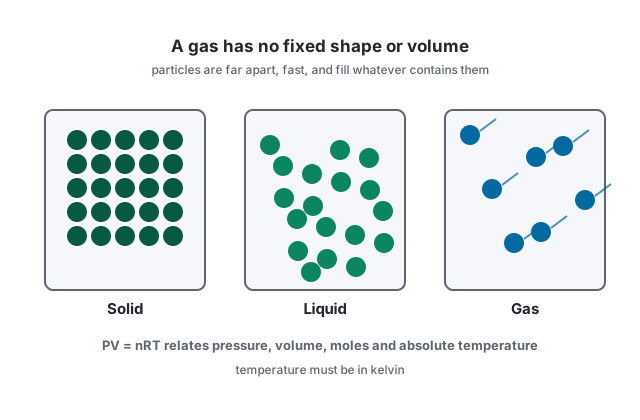
A gas is a state of matter with no fixed shape and no fixed volume, so it expands to fill any container it occupies. Its particles sit far apart and move rapidly in random straight lines, which makes gases easy to compress and quick to mix. Pressure comes from particles striking the container walls.
In more detail
Everything a gas does traces back to how its particles move. Kinetic molecular theory sums that motion up in four ideas: gas particles sit far apart compared with their own size, they travel fast in straight lines in random directions, they attract one another only weakly, and their collisions are elastic, so no kinetic energy is lost overall.
Temperature measures the average kinetic energy of those particles. Those four ideas explain the properties you can observe. Because most of a gas is empty space, the particles can be pushed closer together, so gases compress easily while liquids and solids barely do.
Because almost nothing holds the particles to each other, they keep spreading until a wall stops them, which is why a gas takes both the shape and the volume of its container. Because the motion is random, gases mix on their own without stirring.
What causes gas pressure?
Pressure is force spread over area, and in a gas that force is simply collisions. Every particle that strikes a container wall gives it a tiny push, and billions of those pushes per second add up to the steady pressure a gauge reads. Anything that makes collisions harder or more frequent raises the pressure: adding more gas, heating it, or shrinking the container.
What are the gas laws?
Each gas law holds two variables fixed and describes how the other two trade off. Boyle's law: at constant temperature and amount, pressure and volume are inversely proportional, so P1V1 = P2V2. Charles's law: at constant pressure and amount, volume is directly proportional to absolute temperature, so V1/T1 = V2/T2.
Gay-Lussac's law: at constant volume and amount, pressure is directly proportional to absolute temperature, so P1/T1 = P2/T2. Avogadro's law: at constant temperature and pressure, volume is directly proportional to the number of moles. Combined gas law: P1V1/T1 = P2V2/T2, for when only the amount of gas stays fixed.
Try Boyle's law with numbers. A syringe holds 60.0 mL of air at 1.00 atm. Seal the tip and push the plunger to 20.0 mL at constant temperature, and P2 = P1V1/V2 = (1.00 atm x 60.0 mL) / 20.0 mL = 3.00 atm. Cutting the volume to one third triples the pressure.
How do you use PV = nRT?
The ideal gas law folds all four variables into one equation: PV = nRT, where P is pressure, V is volume, n is the number of moles, T is absolute temperature, and R is the universal gas constant. R equals 8.314 J/(mol K) in SI units, or 0.08206 L atm/(mol K) if you prefer liters and atmospheres.
Choose the version of R whose units match your data. Worked example: what pressure does 2.00 mol of nitrogen exert in a rigid 10.0 L tank at 25 degrees Celsius? Convert the temperature first, since 25 + 273 = 298 K. Rearranged, P = nRT/V, so P = (2.00 mol x 0.08206 L atm/(mol K) x 298 K) / 10.0 L. The numerator comes to 48.9 L atm, and dividing by 10.0 L gives 4.89 atm.
Why must gas calculations use Kelvin?
Proportionality only works from a true zero, and the Celsius scale does not have one. Zero degrees Celsius is the freezing point of water, not the point where particle motion stops. Warming a gas from 10 to 20 degrees Celsius does not double its volume, but warming it from 150 K to 300 K does. Convert with K = degrees Celsius + 273.15.
Molar volume at standard conditions
One mole of an ideal gas occupies 22.4 liters at 0 degrees Celsius (273.15 K) and 1 atm (101.325 kPa). Always quote the conditions with the number, because courses define standard conditions differently. IUPAC's standard pressure is 1 bar (100 kPa), which gives 22.7 L/mol at the same temperature.
When does the ideal model break down?
The ideal gas law assumes particles have no volume of their own and no attraction for each other. Both assumptions fail at high pressure and low temperature. Compress a gas hard and the particles' own volume becomes a real share of the container, so the gas resists further squeezing more than PV = nRT predicts.
Cool it enough and weak attractions start pulling particles together, so the measured pressure falls below the prediction. The van der Waals equation corrects for both effects.
Is a vapor the same as a gas?
Not quite. Gas normally describes a substance that is gaseous at ordinary room conditions, such as oxygen, nitrogen, or helium. Vapor describes the gaseous form of something that is usually a liquid or solid, such as water vapor.
A vapor sits below its critical temperature, so pressure alone can push it back into a liquid. Above that temperature it will not liquefy no matter how hard you compress it.
Diffusion and effusion
Diffusion is gases mixing through random motion, which is how a scent crosses a still room. Effusion is gas escaping through a hole small enough that particles pass one at a time. Graham's law says each rate varies as 1 divided by the square root of the molar mass, so lighter particles move faster.
Helium (4.00 g/mol) effuses about 2.83 times as fast as oxygen (32.00 g/mol), because the square root of 32.00/4.00 is 2.83.
Key facts
| Field | General Chemistry |
|---|---|
| Defining traits | No fixed shape or volume; fills any container |
| Particle motion | Rapid, random, straight-line travel with elastic collisions |
| Governing equation | Ideal gas law, PV = nRT |
| Gas constant R | 8.314 J/(mol K), or 0.08206 L atm/(mol K) |
| Molar volume | 22.4 L/mol at 0 degrees Celsius and 1 atm |
| Temperature unit | Kelvin, required in every gas law calculation |
| Ideal model fails | At high pressure and low temperature |
| Common examples | Oxygen, nitrogen, carbon dioxide, helium |
Leave a bicycle tire in the sun and its pressure climbs even though no air was added. The trapped air sits in a nearly rigid volume, so Gay-Lussac's law applies: pressure rises in step with absolute temperature. Air at an absolute pressure of 4.00 atm warming from 293 K to 313 K reaches 4.00 x (313/293) = 4.27 atm. The molecules did not multiply. They just hit the rubber harder and more often.
Frequently asked questions
Why does a gas fill its container when a liquid does not?
Liquid particles still attract each other strongly enough to stay bunched together, so a liquid keeps a fixed volume and only takes the shape of the bottom of its container. In a gas the attractions are far weaker than the particles' kinetic energy, so nothing pulls them back. They spread in every direction until a wall stops them.
What is the difference between a gas and a vapor?
Gas usually refers to a substance that is already gaseous at ordinary room conditions, like oxygen or nitrogen. Vapor refers to the gaseous form of a substance that is normally a liquid or solid, like water vapor or gasoline fumes. Technically a vapor is below its critical temperature, so compressing it alone can turn it back into a liquid.
Why do gas law problems require Kelvin instead of Celsius?
The gas laws state that volume and pressure are proportional to temperature, and proportions only make sense measured from a true zero. Zero degrees Celsius is just the freezing point of water, not the absence of particle motion. Using Celsius would let a temperature of zero or a negative temperature appear in the math and give nonsense answers. Convert with K = degrees Celsius + 273.15.
What does 22.4 L/mol actually mean?
It means one mole of any ideal gas takes up 22.4 liters at 0 degrees Celsius and 1 atm, no matter which gas it is. The identity of the gas does not matter because ideal particles are treated as having no size and no attractions. If your course defines standard pressure as 1 bar instead of 1 atm, the same calculation gives 22.7 L/mol.
What makes a real gas deviate from ideal behavior?
Real particles occupy space and do attract one another, and the ideal gas law ignores both. At high pressure the particles' own volume becomes a significant share of the container, so the gas is harder to compress than predicted. At low temperature the attractions start to matter, so the measured pressure comes out lower than predicted. Nonpolar gases at low pressure and warm temperatures behave most ideally.
Do gases have mass?
Yes. Gases are matter, so they have mass, but the particles are so spread out that the density is low and the weight is easy to miss. Air at 0 degrees Celsius and 1 atm has a density of about 1.29 g/L, so a typical classroom holds tens of kilograms of air. A sealed flask really does weigh more when filled with a dense gas than with a light one.
How is Boyle's law different from Charles's law?
Boyle's law relates pressure and volume at constant temperature, and the relationship is inverse: shrink the volume and the pressure goes up. Charles's law relates volume and absolute temperature at constant pressure, and the relationship is direct: raise the Kelvin temperature and the volume goes up. The quickest check is which variable the problem says is held constant.
Which gas escapes through a small hole faster, helium or oxygen?
Helium, by a wide margin. Graham's law says the effusion rate varies as 1 divided by the square root of the molar mass, so the ratio is the square root of 32.00 divided by 4.00, which is about 2.83. Helium escapes roughly 2.83 times as fast as oxygen, which is why a helium balloon shrinks within a few days.