Electrolyte
Definition and meaning of Electrolyte in chemistry.
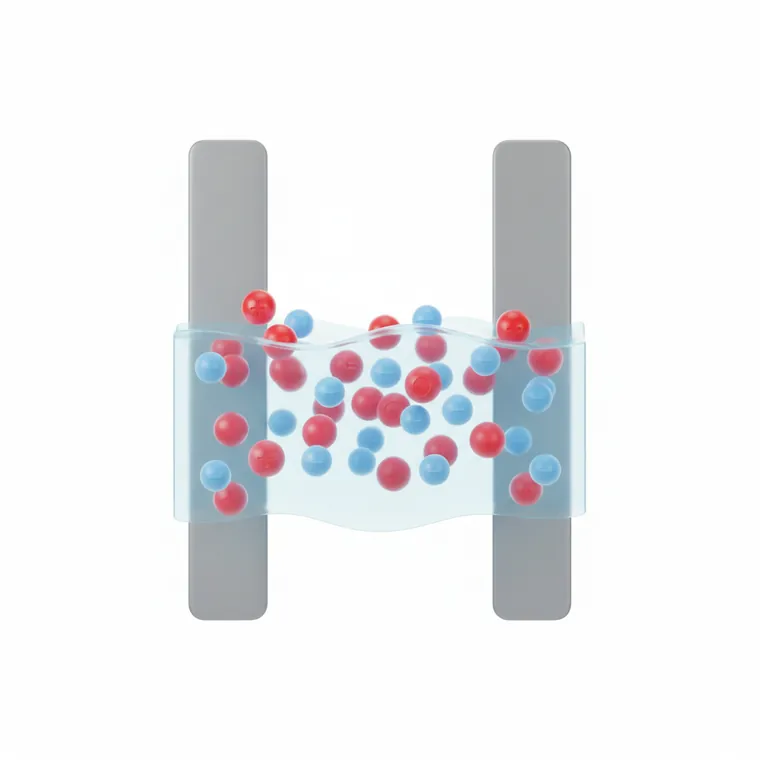
An electrolyte is a substance that breaks apart into free-moving ions when dissolved in water. It can also form ions when melted into a liquid. These mobile ions allow the liquid to conduct an electric current.
In more detail
When an electrolyte dissolves, it releases positive cations and negative anions. If you apply an electric field to the solution, these ions begin to move. Cations migrate directly toward the negative electrode.
Anions migrate directly toward the positive electrode. This physical movement of charged particles carries an electric current through the liquid. Chemists classify electrolytes based on how fully they break apart.
This breaking apart process is called dissociation. Strong electrolytes dissociate almost completely into ions. They include most soluble ionic salts, strong acids, and strong bases.
Their solutions have very high electrical conductivity. Weak electrolytes only partially ionize in water. Weak acids like acetic acid are a good example.
Their solutions contain mostly intact neutral molecules and very few free ions. Therefore, they conduct electricity quite poorly. Some substances dissolve perfectly in water without forming any ions at all.
Sugar is a classic example of this behavior. These substances are called non-electrolytes. A common student misconception is that the water itself conducts the electricity.
In reality, pure distilled water is an excellent insulator. It is only the dissolved ions from the electrolyte that carry the electrical charge.
Key facts
| Field | General Chemistry |
|---|---|
| Charge carriers | Mobile cations and anions |
| Classification types | Strong, weak, and non-electrolyte |
| Strong electrolyte example | NaCl (sodium chloride) |
| Weak electrolyte example | CH3COOH (acetic acid) |
| Non-electrolyte example | C12H22O11 (sucrose) |
Sodium chloride (NaCl) is a strong electrolyte. When you dissolve solid table salt in water, it splits completely into Na+ and Cl- ions. If you place two electrodes in this saltwater bath, a connected light bulb will glow brightly. The free ions flow easily through the water to complete the electrical circuit. A sugar solution would leave the bulb completely dark.
Frequently asked questions
What is the difference between a strong and a weak electrolyte?
A strong electrolyte breaks apart almost completely into ions in solution. A weak electrolyte only partially ionizes, leaving mostly neutral molecules behind.
Is pure water an electrolyte?
Pure water is an extremely weak electrolyte. It self-ionizes just a tiny bit into H3O+ and OH- ions. Therefore, it conducts electricity very poorly.
Why does solid salt not conduct electricity?
In a solid salt crystal, the ions are locked tightly in place. They must be free to move to conduct current. Melting or dissolving the salt frees the ions.